

Written by: Dan Shibilia
TL;DR
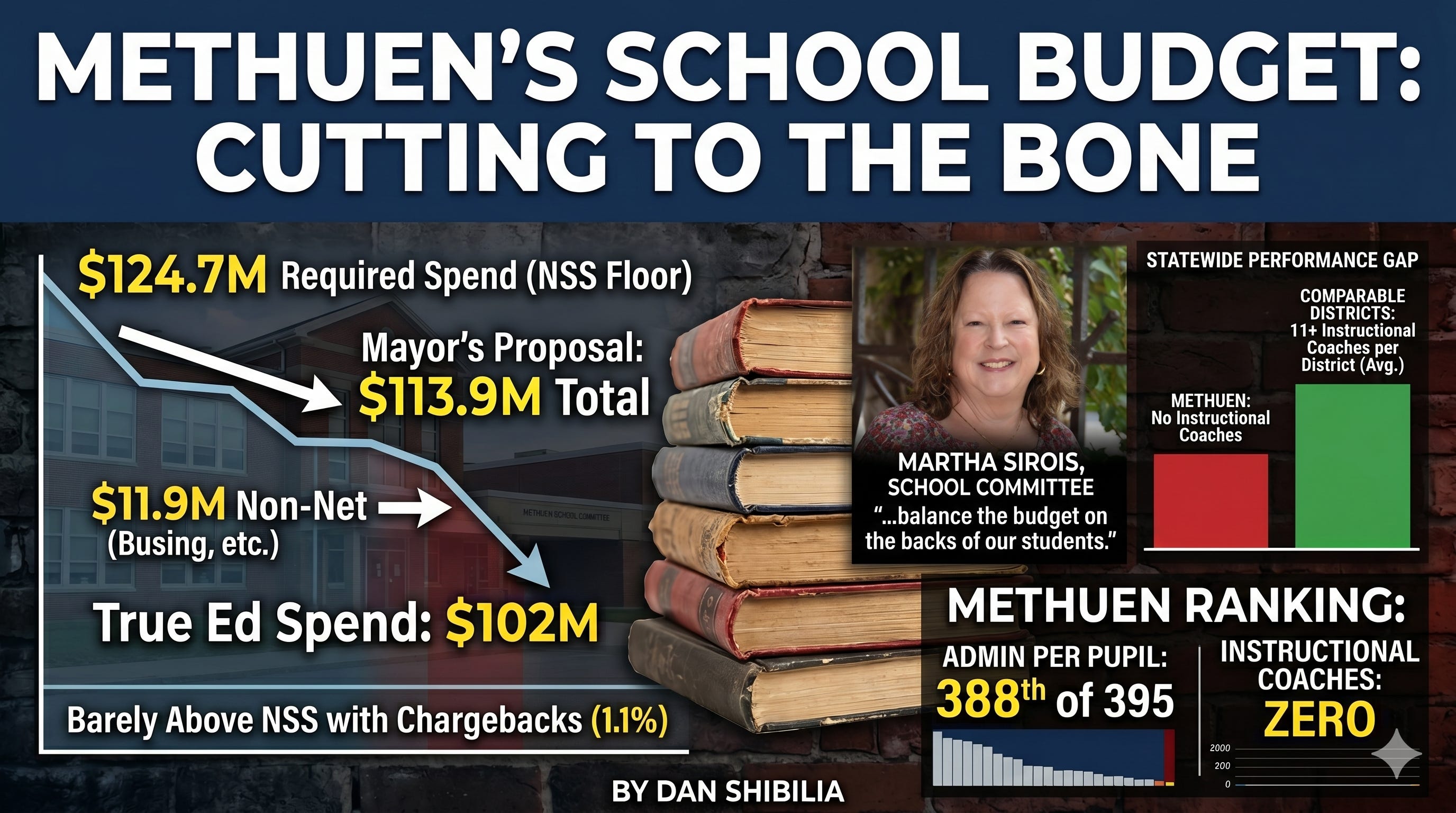
The mayor’s FY27 school budget of $113.9 million sounds close to the state’s required Net School Spending of $124.7 million until you realize it includes $11.9 million in non-net spending like busing. Strip that out and the true educational spend is roughly $102 million. Add an estimated $24 million in chargebacks and the district barely clears the NSS floor by about 1.1 percent. Wednesday night’s school committee session made clear that no one has a plan to close that gap. DESE data shows Methuen ranks 388th out of 395 districts in per-pupil administrative spending and has zero instructional coaches. This is not a district cutting from fat. There is no fat. It’s bleak and there is no getting around that.
The Numbers Every Resident Should See
Foundation enrollment: 6,553 students
Required Net School Spending: $124,723,584
Required minimum city contribution: $52,046,906
Chapter 70 state aid: $72,676,678
Non-net spending (busing, etc.): $11,855,430
Mayor’s total proposed number: $113,976,970 (includes non-net)
True educational spend in the mayor’s proposal: $102,121,540
Estimated chargebacks toward NSS: $24,000,000
Overage above NSS floor: $1,397,956, or approximately 1.1 percent
FY26 Net & Non-net $110M (plus some one-time transfers from free cash not counted here)
Municipal budgeting is a mystery to many… even some of those tasked with doing the job. We are going to recap last night’s School Committee budget workshop and the school budget here. This isn’t meant to illicit fear. This is meant to be educational and informative. We need to understand the problem so we can discuss a path forward.
Let’s get into it…
The school has the mayor’s number and it is $113,976,970, verified directly with the Mayor moments before publishing. He says it exceeds Net School Spending. That’s true but it deserves clarification.
To get a real view, you need to strip out the $11,855,430 in non-net spending, which covers things like busing and other costs that do not count toward the state’s educational spending requirement, and the actual educational investment in the mayor’s FY27 proposal is roughly $102 million. The state requires Methuen to spend $124,723,584 in net school spending to meet its legal obligation for 6,553 enrolled students.
Chargebacks are estimated at around $24 million and do count toward NSS. These are things like Insurance, school resource officers, and shared city resources. Factor those in and the district is at approximately $126 million in total credited spending, which puts it barely above the NSS floor by about 1.1 percent. That’s still a win here in Methuen.
None of this was explained clearly at Tuesday night’s school committee budget session.
The Meeting
Superintendent Golobski opened by framing the discussion around what needs to be protected as the district works toward reductions. It was a hopeful framing for what became a long and uneven session.
Mayor Beauregard was direct about the structural problem. Last year’s school budget was $110.6 million. To maintain level services, the district needs $123 million or more. Proposition 2.5 caps the city’s ability to raise revenue at 2.5 percent annually, and costs are growing far faster than that. He defended the city’s free cash position, noting that relying on it is not sustainable year after year, and made clear that without help from the state, the math does not work.
School Committee Member Nick DiZoglio, joining remotely and without his camera on for the entire meeting, acknowledged what others danced around: the city knew this was coming and did not adequately prepare. He floated ideas including a 1/12 budget to avoid immediate cuts, cutting bus routes, charging for transportation, and exploring partnerships with MEVA. The mayor ruled out the 1/12 approach as an active consideration and explained why a fare-free MEVA partnership does not work if the service is restricted to students, since that would put children on buses alongside the general public.
Member Willette returned to familiar territory. Millionaires tax. State rainy day fund. Cannabis revenues. Gambling receipts. These are legitimate advocacy points at the State House. They are not going to close a gap measured in the millions before we need to present a balanced budget.
Member Keegan offered some of the session’s more grounded thinking. She renewed a push for a virtual academy that would generate revenue without disrupting students currently in school, and noted that cutting high school bus routes does not actually save money because the district pays for the bus whether it makes one run or five. We explored this on the last School Committee.
Member Donovan attempted twice to redirect the conversation toward decisions that are actually within the committee’s control.
“If it’s not in our purview, I don’t think we should be talking about it tonight. Right now we are in survival mode.”
Member Sirois brought some of the sharpest clarity of the night. She noted that there are two weeks left to balance a budget with no clear picture of what state and federal funding will look like. And she said what the numbers actually show:
“Once again we are being asked to balance the budget on the backs of our students.”
Way to go, Martha! I said it last year too and its still true. She also focused on her lived experience with budgeting and the impact after many years in the district.
The mayor, perhaps without realizing it, borrowed language that had been used to describe the district’s situation in earlier coverage, saying the city is not cutting from fat but from bone. That framing is accurate, but it obscures how the district got here. When the official budget number includes non-net spending to make the total look closer to the required threshold, and the gap is framed as a level-service problem rather than a structural underfunding problem, the public does not get the full picture. What he means here is that while other places like Lexington, Westford, Boston, and many others are cutting, they have been well above net school spending for years. In a way, this hurts less. Meanwhile, Methuen has routinely treated net school spending as a goal to meet and now when we cut, it hurts and takes core services away. More on this below.
DiZoglio pushed back on what he characterized as performative politics from the city council side, suggesting some members are more focused on their public image than on solving the problem at hand. He urged the committee to stop speechmaking and start making difficult decisions. He then weakened his own argument by floating cuts to early college and CTE programming. CTE is self-funding and revenue-generating. Cutting these hurts us long-term.
The most concrete outcome of the night was a class size framework. The target is to keep grades 2 through 8 under 26 students, with high school still being worked out. That reconfiguration accounts for roughly $1 million in savings so far. The evaluation is still ongoing.
Member Baez surfaced a concept started by Willette via email, presumably shortly before the meeting, focusing on administrative expenses. Dr. Golobski provides data from DESE that deserves more attention than it got. Methuen ranks 388th out of 395 Massachusetts districts in per-pupil administrative spending, at $408 per student. The highest-spending districts reach $3,000 per pupil. The district has zero instructional coaches. Peer districts have 11 or more each. The persistent narrative that Methuen is top-heavy with administrators is not supported by any data. It is the opposite of what the data shows. However, that narrative will continue as the masses are desperate to cling to something negative to avoid the real conversations.
This Is Not What It Looks Like Elsewhere
Most of the school districts generating budget headlines across Massachusetts right now are cutting from systems that grew substantially over the past decade. Methuen is not.
Lexington, long held as the gold standard of Massachusetts public education, is eliminating 65 full-time positions and sending non-renewal notices to 160 early-career educators, this, just months after voters approved a tax hike for a $660 million new high school. Its superintendent acknowledged that “half of Massachusetts school districts are wrestling with the same pressures we are.”
Boston Public Schools is proposing 300 to 400 position cuts from a district whose central office nearly doubled in size over the past decade as pandemic funding poured in.
Brookline faces the possibility of eliminating more than 200 positions if voters reject a $23.25 million tax override in May.
Salem, North Andover, Newton, and Framingham are all cutting staff and programs. Salem’s superintendent called this “the most challenging year I’ve seen” in 12 years of leading Massachusetts schools.
Statewide, Framingham has voted to cut 51 jobs, Chelsea is proposing 70, Middleborough 29, and Grafton 18. The executive director of the Massachusetts Association of School Committees estimates roughly half the state’s districts are operating with painfully tight budgets.
The shared causes are real: the end of federal ESSER pandemic funding, inflation, rising transportation and utility costs, growing special education caseloads, and federal cuts under the current administration. None of these districts are having an easy year.
But the nature of the cuts is different. When Boston trims positions after its central office nearly doubled, that is a recalibration of a system that had resources to spend. When Lexington cuts teachers six months after approving a $660 million school building project, that is a community adjusting its expectations from a position of historic wealth. Methuen has never been in that position. Its $408 per-pupil administrative spend, 388th out of 395 districts, is not a system with room to trim. It’s zero instructional coaches, compared to 11 or more in comparable districts, is not a system that was ever overstaffed. The positions being cut or left unfilled here were never extras. They were never replacements for something better. They were the minimum. But let’s continue to blame our Superintendent because our kids can’t read.
What Happens if the Gap Does Not Close
If the district cannot close the shortfall without cutting further into positions and services, the consequences are concrete. Special Ed will have difficulty meeting IEP service requirements under federal law. Grammar school class sizes will exceed the targets the committee itself set Wednesday night. The STEM initiative tied to active state grant obligations will lack the coordinator required to fulfill those commitments. Students with behavioral dysregulation at the elementary level will not have intervention support. Families who do not speak English will have no reliable bilingual point of contact at the high school.
These are not theoretical outcomes. They are the documented distance between what the district currently has and what it is legally required to provide.
The meeting ended without resolution. There are two weeks left. The state’s Chapter 70 numbers are not finalized and likely will not be before the Council has to vote on a budget. Federal funding remains uncertain and that is unlikely to change. The structural gap between what Methuen needs to educate its students and what the city can legally raise under Proposition 2.5 is not a problem a virtual academy or a bus route review is going to solve.
Other districts across Massachusetts are falling from heights they built up over years of investment. Methuen never built that height. When Methuen falls, it’s from the starting line and it hurts far more than a fall from glory.
Sources and figures
Methuen School Committee meeting, April 22, 2026 |
FY27 Preliminary Budget documents (Central Office, Tenney, Timony, MHS) |
City of Methuen FY27 budget figures |
Massachusetts DESE district profiles |
WBUR |