

The previous article explained how Chapter 70 is supposed to work. In theory, it is a smart and fair system. The state calculates what each district needs, figures out what each community can afford, and covers the gap. Cities like Methuen, with thousands of low-income students, English learners, and students with disabilities, are supposed to come out ahead because the formula accounts for those higher costs.
But the formula was written in 1993. Massachusetts, education, and the world in general looked very different then. The economy was different. Inflation was different. The demographics of cities like Methuen were different. And in the more than three decades since, the formula has not kept up.
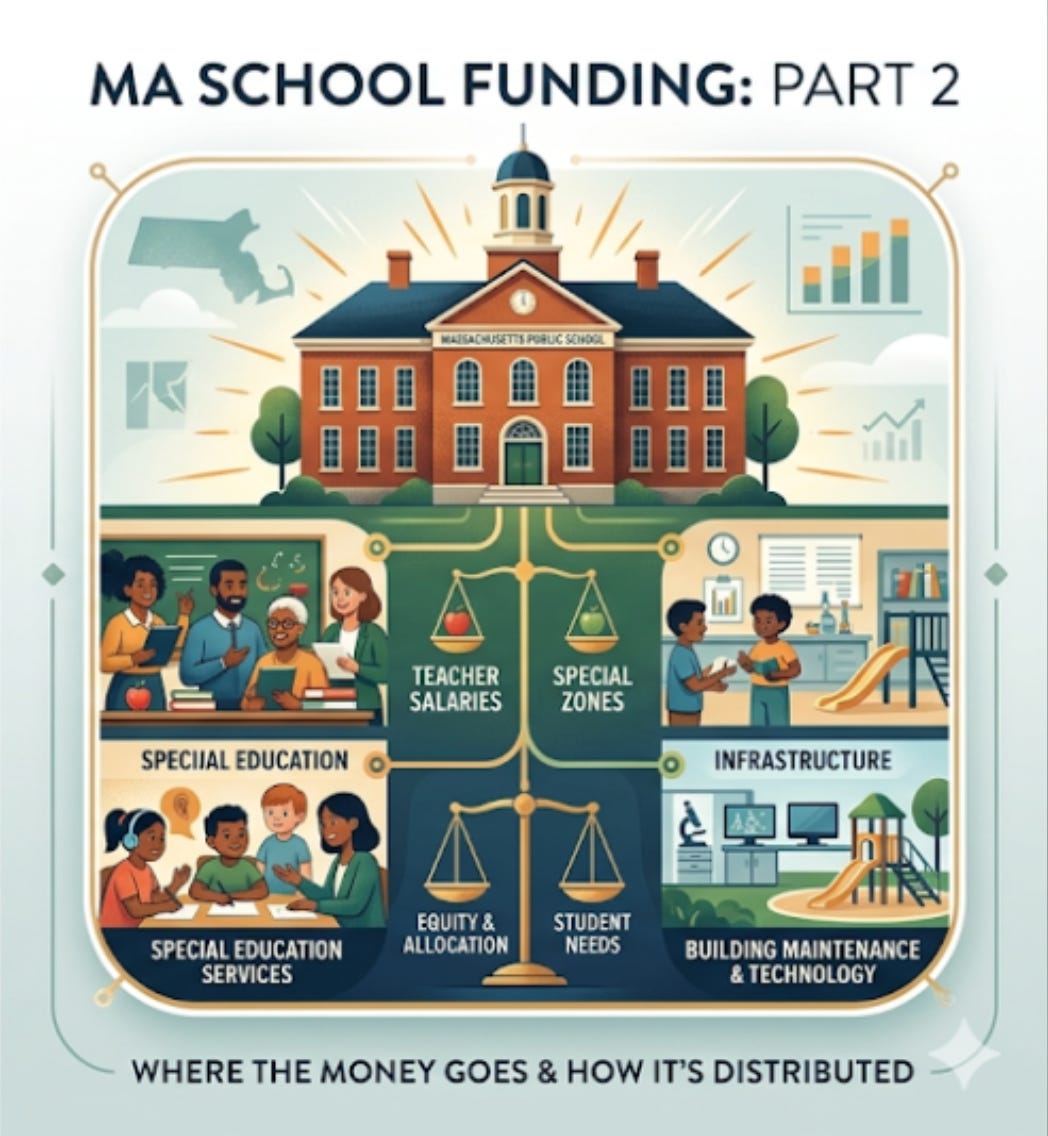
The result is a school system in Methuen facing a multi-million-dollar budget shortfall, layoffs, class size increases, and cuts to nursing, special education staff, and classroom teachers, not solely because the city is mismanaging money (although it's definitely a factor since Methuen has never cared about education)j, but because the formula the state uses to fund public education is fundamentally out of step with reality.
Problem 1: The Inflation Cap Is Too Low
The Chapter 70 formula adjusts its spending rates each year for inflation, but it caps that adjustment at 4.5 percent per year. For most of the formula’s history, that cap was never a problem because inflation rarely reached that level.
Then inflation hit… like a Mac truck.
In FY2023, inflation reached roughly 7 percent. In FY2024, it hit approximately 8 percent, according to the Massachusetts Budget and Policy Center. The formula kept its adjustment at 4.5 percent both years. The difference between what the formula assumed and what things actually cost is now known as the “inflation glitch.”
For reference, the budget for schools years 24-25 and 25-26 were marked for inflation by the Governor well below the cap of 4.5%. To make it all worse, they were both below 2% inflation.
The damage from that glitch is not limited to those two years. Because each year’s funding is calculated as an increase over the prior year, every year going forward starts from that already-undercounted base. The gap never closes on its own. It compounds.
Historical Lookback on Inflation Rates
2021: 4.7%
2022: 8.0%
2023: 4.1%
2024: 2.9%
2025: 2.6%
(https://www.minneapolisfed.org/about-us/monetary-policy/inflation-calculator/consumer-price-index-1913-)
Methuen Public Schools directly experienced this. According to the district’s own collective bargaining documents, an unexpected adjustment in the Chapter 70 formula caused Methuen, and many other districts statewide, to receive 50 percent less than the expected increase in state funding in one recent budget cycle.
MayorBeauregard made the consequences plain in his FY27 budget address: Chapter 70 school aid is increasing by 2.3 percent while costs to maintain level services in Methuen’s schools are rising by 11 percent. That 8.7 percentage-point gap between what the state is sending and what it actually costs to run the schools is not a rounding error. For a district the size of Methuen, it represents millions of dollars of unmet need every single year.
Problem 2: Special Education Costs Are Exploding
One of the fastest-growing pressures on Methuen’s schools is the cost of special education, both for students served inside the district and for students who require placement in specialized programs outside the district.
The Methuen School Committee identified special education cost increases as a central driver of the district’s FY26 and FY27 budget crises. The committee noted an “explosion of special education cases” and highlighted that the rising costs of out-of-district tuition placements alone were contributing to a projected $20 million budget increase necessary just to maintain current services, according to Local Lens reporting from April 2025.
The Chapter 70 formula does include special education funding, but the rates have historically underestimated real costs. The state offers a reimbursement program called the Circuit Breaker to help offset extraordinary special education costs, but it has historically been underfunded relative to actual district need.
A small piece of good news arrived in June 2025 when a state supplemental budget included increased Circuit Breaker reimbursements, resulting in approximately $3 million in additional funds for Methuen, which helped reduce projected layoffs from 42 to 12 for FY26. But that was a one-time legislative fix, not a structural solution. The underlying pressure from special education costs will return in full for FY27.
Fiscal Year OSD Rate Increase
FY2021: ~1–2% (low, pandemic-era)
FY2022: 2.26%
FY2023: ~7–8% (high inflation era)
FY2024: 14% (extraordinary — announced Oct. 2022)
(https://www.mma.org/administration-files-734m-supplemental-budget-bill-with-75m-for-special-education-relief/)
FY2025: 4.69%
FY2026: 3.67%
https://www.mass.gov/special-education-pricing
Over the years, the impact of increases has not kept pace. The state, in its infinite wisdom, did not increase the chapter 70 70 year over year increases in line with the rates in which they were increasing for special ed. Shall we also not forget the increased cost put on businesses by the state that have also increased cost to the schools that have been neglected and unaddressed by chapter 70.
Problem 3: More Than Half of Districts Are Stuck and Getting Less Over Time
The Chapter 70 formula is built around enrollment. More students means more money. Fewer students means less money. This makes sense in principle, but it creates a serious structural problem in practice.
When a district loses students, its Chapter 70 aid would normally fall. To prevent a sudden funding cliff, the formula includes a “hold harmless” provision that guarantees no district will receive less aid than it received the prior year, even if enrollment drops.
In FY2025, 211 out of 360 public school districts in Massachusetts were in hold harmless status, according to the Massachusetts Association of Regional Schools. That means more than half the districts in the state are no longer receiving enrollment-driven formula increases. They are simply being held flat.
The problem is that their costs are not flat. Teachers receive contractual raises. Utilities go up. Insurance goes up. Transportation costs go up. The buildings do not get cheaper to heat just because there are fewer children inside them. Special ed, busing, supplies, and everything else increase regardless of enrollment.
Methuen is not primarily a declining-enrollment district, but the hold harmless dynamic matters for a different reason. Hundreds of millions of dollars in state aid are locked into districts that are shrinking, including wealthier suburban districts, rather than flowing toward high-need communities like Methuen. The wealthiest school districts receive approximately five times more state aid attributable to the hold harmless factor per student than the least wealthy districts, according to a 2022 Boston Chamber of Commerce analysis.
In FY2022 alone, districts statewide received over $613 million in Chapter 70 aid above the formula-derived target… about 11.1% of the total Chapter 70 appropriation, and nearly $100 million more than FY2021.
The hold-harmless provision accounted for $398 million of that, or $425 per student statewide, and the wealthiest 20% of districts received over three times as much hold-harmless aid per pupil as the least wealthy 20%.
(https://www.mbae.org/wp-content/uploads/2021/08/Massachusetts-Still-is-Missing-the-Mark-FINAL.pdf)
Problem 4: The Student Opportunity Act Is Running Out
The 2019 Student Opportunity Act was a genuine achievement. It injected over $1.5 billion in new funding into the Chapter 70 system over several years, with the explicit goal of directing more money to districts with high concentrations of low-income students and English learners. Methuen was supposed to be one of the main beneficiaries.
And for a few years, it was. Methuen received meaningful increases in FY22, FY23, and FY24 that allowed the district to improve staffing and expand programs. But the SOA is being phased in through FY2027, meaning the period of significant annual increases is nearly over. When the phase-in ends, Methuen will no longer be receiving those boosts. The district will be left holding the positions and programs it added, without the funding growth that made them possible.
At the same time, the inflation glitch described above has eaten into the real value of SOA funding. The Massachusetts Budget and Policy Center stated plainly that the high inflation levels seen in recent years were not matched by Chapter 70, and have eroded the value of the SOA.
Problem 5: Transportation Costs Are Crushing Districts
Transportation does not count toward net school spending. That means bus costs are entirely separate from the minimum spending floor. But those costs are very real and they are rising fast.
In Massachusetts, school districts are required to provide transportation to students in certain circumstances under state law. Under M.G.L. Chapter 71, Section 68, districts must provide busing to all students in grades K–6 who live more than two miles from school, and to students in grades 7–12 who live more than three miles away. Transportation must also be provided to students whose routes to school are deemed hazardous… think about walking down Pleasant Street, Forest Street, Pelham Street or Howe Street. Districts may also provide transportation beyond these minimums at their discretion, and many do, but anything beyond the statutory requirements is optional and can be reduced or eliminated through the budget process.
Special education transportation operates under a separate and stronger mandate. If a student's Individualized Education Program (IEP) identifies transportation as a related service, the district must provide it regardless of distance and unlike general ed busing, it cannot be cut for budget reasons. Out-of-district placements in particular often carry significant transportation costs, and as noted earlier, the state's Circuit Breaker program now reimburses districts for a portion of those costs. Federal law under IDEA reinforces this obligation, meaning special ed transportation is one of the few areas of school spending where districts have essentially no discretion once it's written into an IEP.
For a city like Methuen, which has students attending out-of-district special education placements across the region, transportation is not a small line item. The state reimburses some transportation costs, but the Massachusetts Teachers Association notes that reimbursements have historically only covered a fraction of actual costs, and is calling for 100 percent reimbursement.
Methuen’s mayor acknowledged this directly, noting that $1.8 million in one-time free cash transfers were used specifically to cover FY26 special education and school transportation expenses that the Chapter 70 formula does not address. That is a short-term patch, not a solution.
Here's the kicker…. You pay for the bus for the day and not the service in which it's providing for lower, upper, or high school. It has been discussed in the last two school committees (not just the meetings but the actual school committee bodies) about reducing busing for the high school. The reason that doesn't work is because you pay the same for that bus whether it does all three start times or just two.
What Needs to Change
Fix the Inflation Cap
The Massachusetts Teachers Association and Progressive Massachusetts are both backing legislation that would address the inflation glitch by ensuring the formula makes up for the years when inflation exceeded the cap. The bill keeps the 4.5 percent cap going forward but corrects the compounding shortfall from FY2023 and FY2024. For a district like Methuen, correcting this alone could mean millions of additional dollars per year.
Fully Fund the Circuit Breaker
The special education reimbursement program should be funded at a level that reflects actual out-of-district tuition costs… costs that are actually set by the same leaders who set chapter 70. One-time legislative fixes like the one that helped Methuen in June 2025 are not reliable. Districts cannot budget around surprises.
Reform Hold Harmless
Locking hundreds of millions of dollars into shrinking, wealthier districts while cities like Methuen face cuts is an indefensible outcome. Reform should redirect those dollars toward the places with the highest student need and the least local fiscal capacity. Any reform of hold harmless must include protections for genuinely struggling rural districts that have no other options.
Reimburse Transportation Costs Fully
The artificial separation between transportation and instruction creates a funding illusion. Districts are required to provide transportation. The state should fund it adequately. Pretending it doesn't exist. Does not make the cost go away.
Establish a New Foundation Budget Review Commission
Several state senators, including Senator Jo Comerford, have called for a new commission to comprehensively reassess the formula. The last such review was the Foundation Budget Review Commission that led to the SOA. Given how much has changed since 2019, another comprehensive review is overdue.
What This Means for Methuen Right Now
Methuen is a perfect storm. Decades of neglect coupled with the failing chapter 70 system has us in tough spot. Still, the Schools followed the formula, expanded programs when funding came in, served one of the most complex student populations in the Merrimack Valley, and is now being squeezed from every direction at once.
Methuen ranks 388th out of 395 districts in per-pupil administrative spending and has zero instructional coaches. There is no administrative bloat to trim. There are no easy cuts left. Methuen faces a shortfall approaching $9.6 million for FY27, and the school committee is already looking at reductions in nursing staff, special education support, and classroom teachers.
A student at Northampton High School testified at a 2025 state hearing that the funding formula is older than she is. The same is true for students in Methuen. They are attending schools funded by a formula that was designed for a Massachusetts that no longer exists. Until the state fixes Chapter 70, Methuen’s children and their teachers will continue paying the price.
Sources
MassBudget, Chapter 70 Local Contribution Study Written Comments, December 2025: massbudget.org
Massachusetts Teachers Association, Fiscal Crisis Campaign: massteacher.org
Progressive Massachusetts, Funding Our Schools: progressivemass.com
Boston Globe, “Methuen mayor, School Committee divided,” June 13, 2025: bostonglobe.com
Inside Methuen, “Built to Fail,” April 23, 2026: insidemethuen.com
City of Methuen, FY27 Budget Presentation and FY26 Budget Update: methuen.gov / cityofmethuen.net
Methuen Public Schools, Collective Bargaining Updates: methuen.k12.ma.us
Local Lens, “Methuen School Committee Faces Budget Constraints,” April 2025: thelocallens.org
Statehouse News Service, “Methuen teachers decry budget cuts,” June 2, 2025: statehousenews.com
NBC Boston, “Shortfalls Fuel Growing Call for Mass. Education Funding Overhaul,” March 2025: nbcboston.com
Boston Chamber of Commerce, “Missing the Mark,” 2022: bostonchamber.com
Hoodline, “Methuen Scrambles to Close $9.6M School Funding Gap,” April 2026: hoodline.com
Citizen Portal, “Methuen School Committee Debates Steep FY27 Cuts,” April 28, 2026: citizenportal.ai
Athol Daily News, “Pioneer Valley educators push for Chapter 70 reform,” November 2025: atholdailynews.com