

Written by: Dan Shibilia
Corresponding preview article: Here.
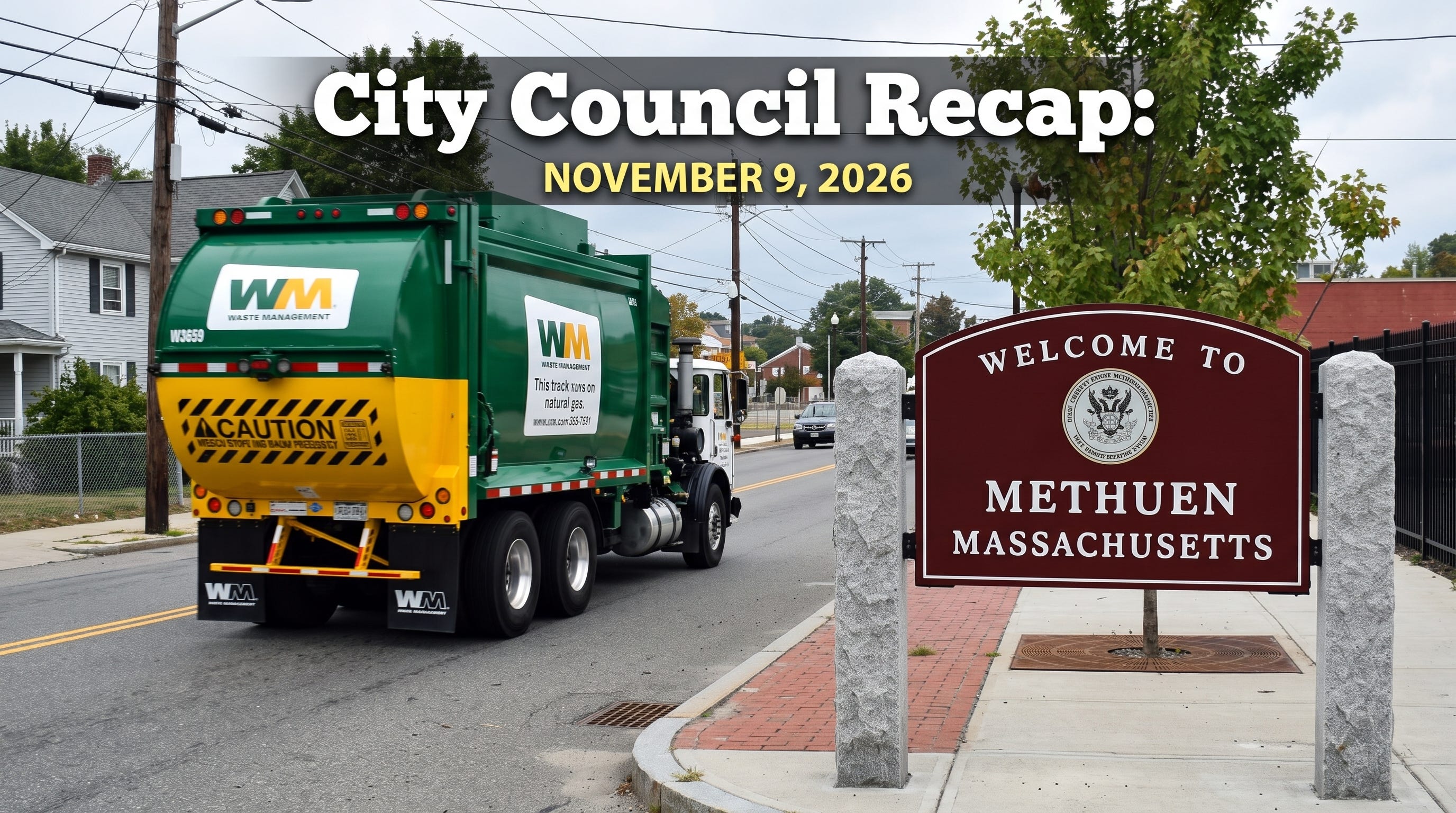
Tonight was round two of the trash contract. Last meeting it was tabled after the Council went round and round talking about having questions they didn’t want to ask. It was a stall that fooled nobody. This time it came back with a full house watching, and it passed 5-2-2 with the Waste Management contract intact..
It’s worth noting who made up that full house, because it explains a lot about the night. The crowd was largely members of the city’s 55+ communities, which carry real political clout in Methuen for the simplest of reasons: they vote. They make up a sizable voting bloc in both the West and East Districts. Trash and recycling service has been one of their signature issues for a long time, and they organized around it by sitting down with the council candidates to figure out who would actually fight for the services they believe they’ve earned. Valley and Soto came out as their picks, and tonight we got to watch that endorsement play out in real time. The condo communities have a coalition of their own, which I affectionately think of as the Dons, mafia-boss style.
The path to completion tonight was messier than the vote suggests. A motion to table failed first. The company that lost the bid, Harvey, somehow ended up at the podium. The public hearing also closed without a single resident getting to speak, though residents did get their three minutes later, during Public Participation.
Let’s get into the meat of the meeting….
Public Hearing
The meeting opened with a public hearing on the contract, and Soto described it as a “full house.” She had requested an overflow room on the second floor so that people could watch on TV. MacLaren and Santos were absent due to standing conflicts.
Soto gave the mayor the floor first. He said he keeps hearing the desire for change in the city, and that this contract delivers it. He pointed out that Waste Management is the largest company of its kind in America, and he addressed the elephant in the room directly: the hall was full of 55+ and condo residents for whom this contract changes nothing. He also touched on the recently issued executive order on recycling.
Soto then acknowledged who was in the room, naming Director Bower of DPW, Waste Management, Harvey, and the Methuen Housing Authority.
That last name on the list was the awkward one. Harvey lost the bid, and nobody said who invited them, so we’re left to assume it was Soto. Hold that thought, because it comes back.
A Waste Management representative opened the company’s presentation by saying it prides itself on being the most eco-friendly operator in the business, and he highlighted its capabilities and recent investments. He then recounted how the process got here: the original bid went out six months ago, and the company has been working with the mayor and his staff ever since.
He said they had built a number of savings opportunities into the proposal, including yard-priced dumpster pickup, a two-man truck in the Arlington neighborhood, 24/7 web-based customer service, and ways to reduce tonnage such as bulky-item handling and bin management. He then answered a batch of submitted questions about trucks, staffing, timing, and transition planning.
The company can evaluate routing and day balancing to keep service consistent, he said. It will need to use rental trucks at the start, since new trucks are 12 to 15 months out but that cost will be consumed by them and not the City if we sign soon. This is where Soto took issue with being pressured to move faster. Residents can report problems online to Waste Management directly or by phone through the city, and the company would meet with the city monthly to keep small issues from becoming big ones.
Council questions came next, starting with Marsan, who asked how barrels without the new stickers would be handled. The rep said this isn’t a Methuen-specific process and walked through the company’s standing procedure.
Drew asked about dry runs before the contract begins, and the rep said a team runs the routes and uses GIS to identify problems in advance. He added that Waste Management served the city years ago, so none of this is new territory. Drew also asked about bilingual capabilities, and the rep explained that the trucks are automated, so there is little direct interaction with residents, but bilingual staff will be assigned.
DiZoglio asked whether tonnage is included, and it is not. He also voiced concern about the city’s new ordinances for fines, which the solicitor clarified apply to residents rather than the vendor. DiZoglio then said he didn’t like how the contract gets bigger over time, and the rep answered that it works the same way as the current one.
Pesce asked about the rollout in Arlington, which is in its second year with Waste Management, and the rep said the barrel program went well overall. Simard asked about truck counts, noting that Harvey ran five trucks and struggled. The rep said Waste Management would run six, plus the two-man truck in Arlington. Simard also asked whether the company could help fund the waste czar so she can do her job, and the rep said they always work with the city.
Soto asked why, if the company is so large, the city needs to order trucks at all. The rep clarified that they do have trucks but believe Methuen deserves new ones. Soto then moved straight into what amounted to a break-up plan: wean the city off Waste Management and do our own trash, adding that “Harvey is willing to do it.” She asked whether Waste Management would entertain that, and the rep said they were willing to explore options.
She kept returning to the condo and 55+ residents, who pay taxes but receive no trash service, and she began trying to negotiate the contract’s terms from the dais. Drew closed the hearing’s questions by asking for confirmation that there would be no rental fees, and the company confirmed there would be none.
The hearing then closed without a single resident being given the chance to speak, and the meeting rolled directly into the regular agenda.
This was campaign material by Soto. She made the entire exchange awkward. At no point did she ask a question that would help insure the residents in her district or the rest of the City could get decent service. Her focus on the 55+ complexes make her look bought and paid for which is very typical Methuen politics.
And,… what did she want the vendor to say when she asked their opinion on doing trash in house? Think about “can we eventually fire you and do this work ourselves?” Why would they talk themselves out of work? This was nothing more than theather.
Regular Meeting
Roll call was taken again, with the same two councilors absent, and the agenda was accepted. Soto then opened Public Participation by noting that the Council had received more than 130 emails, which would be entered into the record but not read aloud.
Dean Groves was the first to speak, and he talked about his home on Pine Tree Drive, saying residents there had not known about the lack of trash and recycling service.
Linda Soucy raised a safety concern about trucks traveling the wrong way on the one-way street in the Arlington neighborhood where the Center is and where children come and go all day. She also asked the Council to reconsider putting trash on the Housing Authority’s own budget, which she said would severely hurt residents.
Annmaire Moglia, director of the Housing Authority, said the average household income there is $22,000 and the average rent is $512, so any change would have a serious impact.
Ed Johnson said he wants to go back to in-house trash pickup, since we now know what the equipment would cost.
Ellen Weinhold, who works for the Housing Authority, said the people filling the room had purchased high-cost homes and that she was there to speak for senior and disabled housing residents. Her message to the Council was this: “I know we are all hurting but don’t hurt the MHA residents.”
Bill Burke walked through his math showing that 55+ residents pay far more in taxes, and he said giving them trash pickup would be a “thank you for your service” to veterans.
Steve Travese spoke about hydraulic leaks in the Harvey trucks and also supported keeping the service in house.
Emily Evans ended up in a conversation with the mayor, and she said she appreciated the pending recycling program.
Ken Frankel spoke about the taxes the 55+ communities generate and their zero impact on schools, and he said residents did not know when they bought their homes that trash and recycling would not be included.
Gil Rodriguez, who is the “leader” of the 55+ complex coalition, recalled that former Mayor Perry believed it should be all or none when it comes to condos, restated that he does not want to challenge the Housing Authority, and acknowledged that it pays $33,000 a year in taxes while condos pay far more. He also invoked the mayor’s inauguration speech about equal treatment from City Hall.
Sabrina Peavey closed out the public comment by describing what her complex pays and arguing that it should receive the service.
With public participation closed, the Council returned to discussion. Drew went back to Ed Johnson’s figure from the Tribune article, and the CAFO said the paper’s number was all-inclusive of tonnage. Drew also asked about the time limit per home that had come up during public comment, and the rep said there is no time limit and that the company is contractually bound to clean up its own mess.
DiZoglio returned to the increased fee, but more importantly to the city’s ability to hold the vendor responsible under the contract.
He is not wrong, and it’s a fair point. As a city we have never been good at holding anyone accountable… ANYONE… whether that’s employees or vendors, and a contract is only as good as the enforcement behind it.
Marsan asked about the term and the figure, and the CAFO explained that Harvey’s bid is $1.5 million cheaper, though that comparison does not include tonnage or yard waste. Marsan asked why the city would pay for yard waste when it already has a packer. The mayor said it is an option because of staffing and that the city may need it, and Bower added that the department does not have the staff and that yard waste can monopolize an entire department for a whole season.
Marsan also asked about a fuel charge listed at $4.21 a gallon when its over $6 per gallon. The rep explained that the figure Marsan cited is for diesel, and that Waste Management runs natural gas trucks, which see far less volatility in cost.
The mayor then jumped in to address DiZoglio’s accountability concern, pointing to the trash czar as the key function for enforcing contract terms. He acknowledged the sticker shock the Council was feeling and called attention to the improvements and upgrades in service.
Drew asked why the contract runs for five years. The mayor explained that it is exempt from Chapter 30B, the state’s procurement law, but that a five-year term is best practice and gives the city more predictability than three. Drew then asked about the service-level agreements and what teeth they carry, and how many of the old contract’s provisions did not make it into the new one. The mayor said sanctions don’t guarantee good service and that he believes the contract sets up a sufficient system.
Drew’s larger worry was the lack of a termination-for-convenience clause, which leaves the city stuck in the deal unless there is cause. The solicitor explained that the contract remains subject to appropriation by law so it’s not a real problem.
Valley asked about the letter the mayor sent to the 55+ communities and why the contract can’t simply be amended. The mayor said this isn’t an up-or-down vote on that question and that the bid alternate could come back soon. She asked what the new program would cost, and he said the numbers are preliminary and modeled on Haverhill’s system, with the plan being to get it done quickly. Valley also asked about the two group homes listed in the RFP, and the mayor confirmed they are owned by the Housing Authority. The mayor didn’t have a real number on cost yet.
Soto then took aim at the Housing Authority, raising a hypothetical about removing it from trash service. She also brought up group homes in the city that are not part of the Housing Authority, whether state-run or privately operated, and suggested they could come forward saying they are a group home too and want equal treatment. “This gets messier and messier,” she said.
Then she called Harvey to the podium. She asked whether they had priced the Housing Authority and recycling, and they confirmed they had, with the CAFO confirming it was done the same way Waste Management did it. Soto said “everyone wants to talk at once and I got called by a fellow councilor for letting you guys go rampant on the floor,” a remark that came right after the CAFO had answered the question asked.
She went on to the $5 million and $7 million figures with a snarky comment about paying for the trucks and said she wanted to make sure the bids were “apples to apples.” She finished by asking the Harvey rep how feasible it would be for Methuen to go private and do trash in house “in 3-5 years.” He described a community he helped through that process, the problems they hit along the way, and his sense that more communities are moving away from the private model. The mayor noted that the bid alternate was the same for every bidder.
Let me be clear about what happened here. The CAFO was speaking because a question was asked, and her remark about floor control landed as a deflection the moment she didn’t like his answer. This is a pattern with her: little control, little decorum, favorites, and rules that apply when they’re convenient. And whether the bids are apples to apples is not the Council’s job to decide.
Let’s circle back to Harvey. Why were they there? Who invited them? Why is Soto pushing so hard for them to be the vendor of choice until she can force trash back in house? None of it makes sense.
Simard said none of this is personal toward the Harvey team, and he called going in house unrealistic. He said he supports funding for the Housing Authority but wants more oversight to cut costs, and that while he would support a compromise on homeowners’ associations, that is not what is on the table tonight.
This was probably the smartest thing said all night.
DiZoglio talked about a these seniors in 55+ buying a “house that fits their needs,” referencing Toll Brothers and saying “they raised us,” so now the city needs to give back. He then argued that bringing trash in house would be costly up front and cheaper in the long run, and that this was one more case of Methuen not looking at the long term.
Soto passed the gavel and moved to table the contract until the first meeting in December, asking the mayor and DPW to close the gap between the two companies and to include the Housing Authority, condos, and 55+ communities. She also wanted a three-to-five-year plan for transitioning to city-run trash, along with a planned vendor investment in the transfer station. Valley seconded.
There was an awkward exchange right after Pescce took the second and called for discussion. It was a reasonable mistake and happens pretty often. The solicitor pointed out that a motion to table gets no discussion. However, Simard asked whether the Council would have the information it needed before that December meeting. The solicitor chimed in to remind the body that contracting is an executive function and that the Council may vote yes or no, but it cannot change the contract, and the matter returns to the body every June for appropriation.
Soto was not pleased. “Mr. Solicitor, you just did a whole explanation when we weren’t supposed to have any discussion,” she said.
Is she really upset that she wandered well outside her lane and the solicitor had to say so? She doesn’t like being challenged, but he was right and she was wrong. His legal assessment and advice to the body that employees him to render such advice was that they were getting outside their lane. However, since Soto was the one driving that runaway bus, she didn’t like it.
The motion to table failed 3-4-2, with Valley, Marsan, and Soto in favor and MacLaren and Santos absent. The mayor then said he is open to setting up a cost estimate and feasibility study for bringing trash in house.
Soto called the question, and the solicitor noted that five votes are needed to pass. The contract passed 5-2-2, with Valley and Soto voting no. It went to a quick motion to close the meeting and that’s all she wrote.
It’s odd to me that Marsan voted to support the table but then voted to support the contract. The logic is just not there. It’s also pretty telling the the two reps, both real estate agents who represent districts with heavy 55+ voting blocks, voted for no and pushed for those communities to be included.
It’s a good play. The contract passes and they look good in front of their residents. They get to say they supported their efforts for trash and recycling.
That’s a wrap on November 9, 2026. The full agenda is available at the City of Methuen website and meetings are archived at MethuenTV.
Have a tip, a correction, or something you want covered? Reach out.
Interested in writing for Inside Methuen, let’s talk!