

Written by: Dan Shibilia
Over the last few weeks, news hit the City Councilors and School Committee members that they would be treated as eligible for health insurance when the city moves to the state’s Group Insurance Commission (GIC) on January 1, 2027.[1]
They shouldn’t be.
Methuen’s own ordinance says they are not eligible. The council tried to change that last December and failed. Inside Methuen then learned from several elected officials that the same benefit may be arriving through the state’s system. When I started this article earlier in the week, I was prepared to say this was being done without a vote and should be stopped.
Enter TR-26-99.
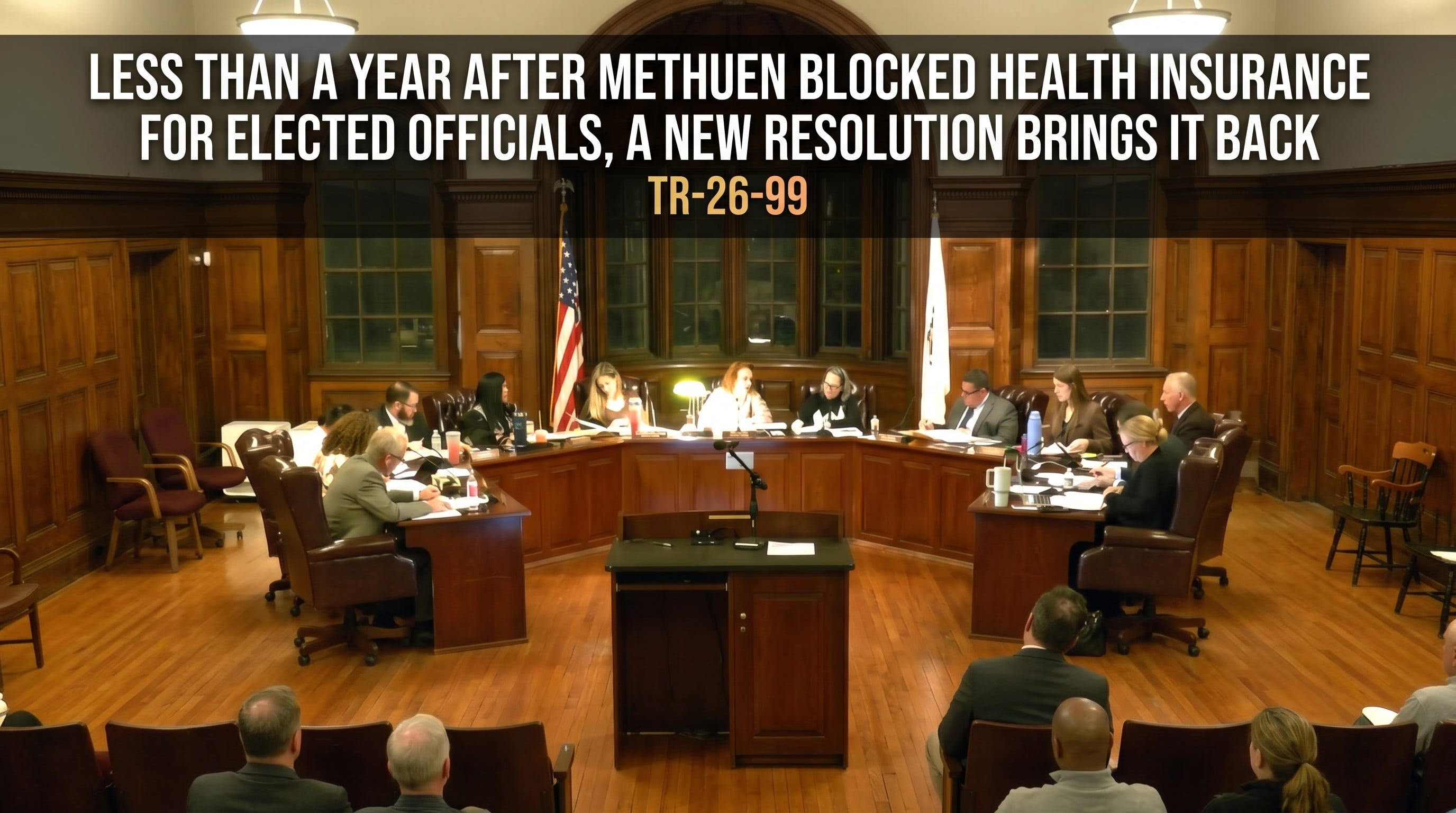
Today, while working on the preview article for Monday’s Council meeting, Resolution TR-26-99 appeared on the council agenda.
Resolution TR-26-99, titled “Resolution Regarding Group Insurance Commission Eligibility” requested by Mayor Beauregard, would make “persons elected by popular vote” eligible for GIC health insurance “during the entire term for which they are elected.” It would take effect upon the city’s Notice of Transfer to the GIC. Only members of mosquito control projects and local housing and redevelopment authorities are carved out. This is up for a first vote at the Council meeting on November 2nd.
Ten months ago, the same idea was stopped. It should be stopped again.
What the mayor got right
First and foremost… credit is due where it is earned. Joining the GIC was the right call, and Mayor Beauregard was the driving force behind the effort. The agreement the mayor and the Public Employee Committee ratified in June moves employees, retirees and their families to the GIC on January 1, 2027. The city projects savings of at least $11.2 million through fiscal 2030 for the city, employees and retirees, and says deductibles will be more than 50 percent lower. It also ends the city’s exposure to claims under a self-insured system, and the city has said the savings put it in a position to make additional investments in public education. The Public Employee Committee, led by President Kara Blatt, deserves a lot of praise for working through the tedious process and reaching a successful agreement.
The work of getting everyone enrolled has been just as demanding. The mayor told Inside Methuen that the city’s GIC enrollment team has been signing up retirees who cannot be reached by email or phone, in person. He said about 496 eligible people had not enrolled as of last week and that the number is now roughly 10 retirees, after he secured an extension of open enrollment to Friday, November 13. He also said Nevins Library staff will keep their coverage because the city is adding them to its retirement system, and that alternatives are lined up for workers who pay into OBRA and are not eligible.
The city already said no
The city’s pay ordinance, in effect since January 1, 2024, sets councilor pay at $10,000 a year and School Committee pay at $6,000. It states that elected members of both bodies are not eligible for city health insurance because they do not work 20 hours a week for the city.[2] The Eagle Tribune has reported that an earlier council removed the insurance option while raising elected officials’ pay.[3]
In December 2025, the council tried to reverse that. On December 15, councilors approved, 5 to 2, a resolution (TR 25 73) letting themselves and, by amendment, School Committee members opt into city insurance on the same basis as city employees.[3][4] Mayor Beauregard vetoed it. At a packed and raucous special meeting on December 30, the override failed 5 to 2, one vote short of the six the charter requires, with only seven members seated.[5][6] The Eagle Tribune reported that elected officials would remain ineligible.[5]
The idea did not lose on the merits among councilors. It was blocked by a veto the council could not override. The mayor’s stated concern was that the resolution had been approved without a thorough analysis of its fiscal impact.[7] The city’s own estimate at the time put the cost at roughly $86,000 to $250,000 a year for nine councilors, depending on the plan, and the Eagle Tribune reported it could pass $400,000 a year if all 15 possible officials enrolled.[3][5]
What state law says
Two Massachusetts laws cover public health insurance, and they treat elected officials differently.
Chapter 32A, which governs the GIC, says anyone elected by popular vote is eligible, no matter how many hours they work.[8]
Chapter 32B, which governs city and town plans, says an elected official who works less than half time can be covered only if the city chooses to allow it. This is called a “local option.”[8]
In 2013 the GIC said that when the two laws conflict, the city’s 32B choice controls.[8]
Today’s GIC regulations say the same thing in practice. Officials elected by popular vote are eligible, but those whose regular work week is under 18.75 hours are covered only if the city opts in, and cities must tell the GIC each year, by May 1, about any change.[9] The 2013 bulletin also says the GIC would assume a city’s past practice reflected its local choice unless told otherwise.[8]
There is a catch.
Once a city moves its employees to the GIC, the GIC makes the final eligibility determinations, and if it concludes someone is not eligible, that decision is final.[10] If Methuen did not clearly tell the state that its elected officials work under the threshold and are out, the state’s default could treat them as in. If the city did report them as eligible before any council vote, that was a decision made behind residents’ backs. That is why the public needs to know what the city told the GIC. Inside Methuen’s records request is pending with the State.
Then the resolution appeared
Since Methuen currently has an ordinance that exempts the part-time elected officials from health insurance, they needed TR-26-99 if they want to get them coverage. Its wording is not limited to councilors and School Committee members. The city should say exactly who it covers. It also does not say that it amends or repeals the 2024 ordinance, and it does not dispute that elected officials work fewer than 20 hours a week. To be fair, the 20 hour a week rule is no longer relevant under the 32b.
The resolution’s own words matter. It says “applicable law and GIC regulations permit participating municipalities to consider persons elected by popular vote employees eligible,” and, since the mayor is bringing this resolution forward, it would appear that the mayor now supports “exercising the local option to extend eligibility.”[11] That treats eligibility as something the city must choose to extend. If so, no elected official should be treated as eligible until the council votes.
They should also clarify the language as to which elected officials. Will this cover Methuen’s GLTS members? How about the Nevins Trustees?
What has and has not changed
Something real has changed. Methuen is leaving its self insured system for the GIC on January 1, 2027, and, as stated earlier, the city projects savings of at least $11.2 million through fiscal year 2030 for the city, employees and retirees combined.[1] TR 26 99 leans on that fact.
But those savings belong to the transition. They are not a price tag for adding elected officials In December the objection was a missing fiscal analysis. The CAFOs report gives us one.
What it would cost
The attached CAFO report on the agenda puts a number on it. A city summary of TR 26 99 says three elected officials have expressed interest in joining the GIC, at an estimated cost of about $77,000 a year. That figure is based on an average of roughly $26,000 per subscriber across the city’s family plan options. Because the switch happens in January, the summary puts the fiscal year 2027 impact at about $38,500 and says the health insurance budget “appears sufficient” to cover it without a new appropriation.[12]

That estimate counts only the three officials who have spoken up so far. The resolution opens eligibility to every elected official for their entire term, and to whoever holds those seats in the future. At $26,000 per person, all nine councilors would cost about $234,000 a year, and 15 eligible officials would approach $390,000. Those numbers line up with the city’s own December estimate of up to $250,000 for nine councilors and the Eagle Tribune’s report that the cost could pass $400,000.[3][5] The summary itself says the figure will move depending on which plans officials pick and whether they take single or family coverage.
In December, the mayor vetoed the last version because it lacked a thorough analysis of its fiscal impact. A single paragraph that prices three unnamed enrollees and says the budget “appears sufficient” is not that analysis. Before anyone votes, the council should see the cost if every eligible official enrolls, broken out by single and family plans, projected over several years.
Who should(n’t) be voting?
The State Ethics Commission has addressed this kind of situation. In a 2011 letter written about the state’s municipal health insurance reform law, its general counsel said the conflict of interest law, G.L. c. 268A, section 19, bars city councilors from participating in matters where they have a foreseeable financial interest, and that a councilor with municipal health coverage, or who intends to get it, has such an interest.[13] The letter describes exceptions. An official who will not enroll, for example because of coverage through a spouse, may vote. A general policy exception exists, but the Commission reads it to require that a substantial segment of the town’s population, at least 10 percent, share the interest. And a rule of necessity can apply if conflicts leave a body without a quorum.
That letter was about a different statute, so Inside Methuen is not saying it settles the question here. We are saying the question has to be answered before the vote. Each councilor should state publicly, on the record, whether they intend to enroll, and the solicitor should say who may lawfully vote.
If nothing else, any vote should not take effect until after the next election otherwise the conflict of interest in real.
Better candidates?
Supporters will argue, as the December sponsor did, that coverage promotes fairness and equity, encourages civic participation and helps recruit qualified people. They will also note that state regulations treat popularly elected officials as eligible for GIC coverage, with the choice left to the city where the official works under 18.75 hours a week.[9] Those are fair arguments to make… especially if you don’t know the history of the Council.
Our view is that they do not hold up. It’s important to remember, health insurance was once a benefit of the council position. There is little to be said about past councils that would suggest they were better than what we have had since removing the benefit. Nothing in TR 26 99 offers evidence that a health benefit produces better councilors. A benefit attached to a $10,000 a year part time post is just as likely to draw candidates who want the coverage as candidates who want to serve. The people asking taxpayers to pay for it are the people who would receive it, less than a year after being told no. That is overreach, and members who vote yes should expect to answer for it.
I am curious how this all unfolds. More to come after the meeting.
Sources
1. City of Methuen, Mayor and Public Employee Committee announce GIC agreement (June 25, 2026)
2. City of Methuen, compensation ordinance for elected officials (effective Jan. 1, 2024)
3. Eagle Tribune via InsuranceNewsNet, Council approves insurance option for elected officials
4. Methuen City Council meeting minutes, December 15, 2025
6. Eagle Tribune via InsuranceNewsNet, Methuen council plans special meeting for Tuesday
7. Blank.
9. 805 CMR 9.02, Elected Officials, via Justia
10. Mass.gov, Coverage and Eligibility for Municipal Group Insurance
11. City of Methuen, TR 26 99, Resolution Regarding Group Insurance Commission Eligibility (requested by Mayor Beauregard)
12. City of Methuen, CAFO report on TR 26 99, City Council agenda for November 2, 2026