

An opinion piece backed by fact for Inside Methuen
Written by: Dan Shibilia InsideMethuen@gmail.com
Methuen is in the middle of one of the most painful budget seasons this city has seen in a long time. Word is already circulating that we are staring down furloughs and layoffs across nearly every department. Services that residents count on are being restructured or stopped outright. Some of this is squarely on the city itself, the result of decades of weak economic development and a government structure that was never truly built to balance efficiency with effectiveness. That is an honest conversation we need to have as a community, and it is long overdue.
But that is not what this is about today.
Today I want to talk about one question…
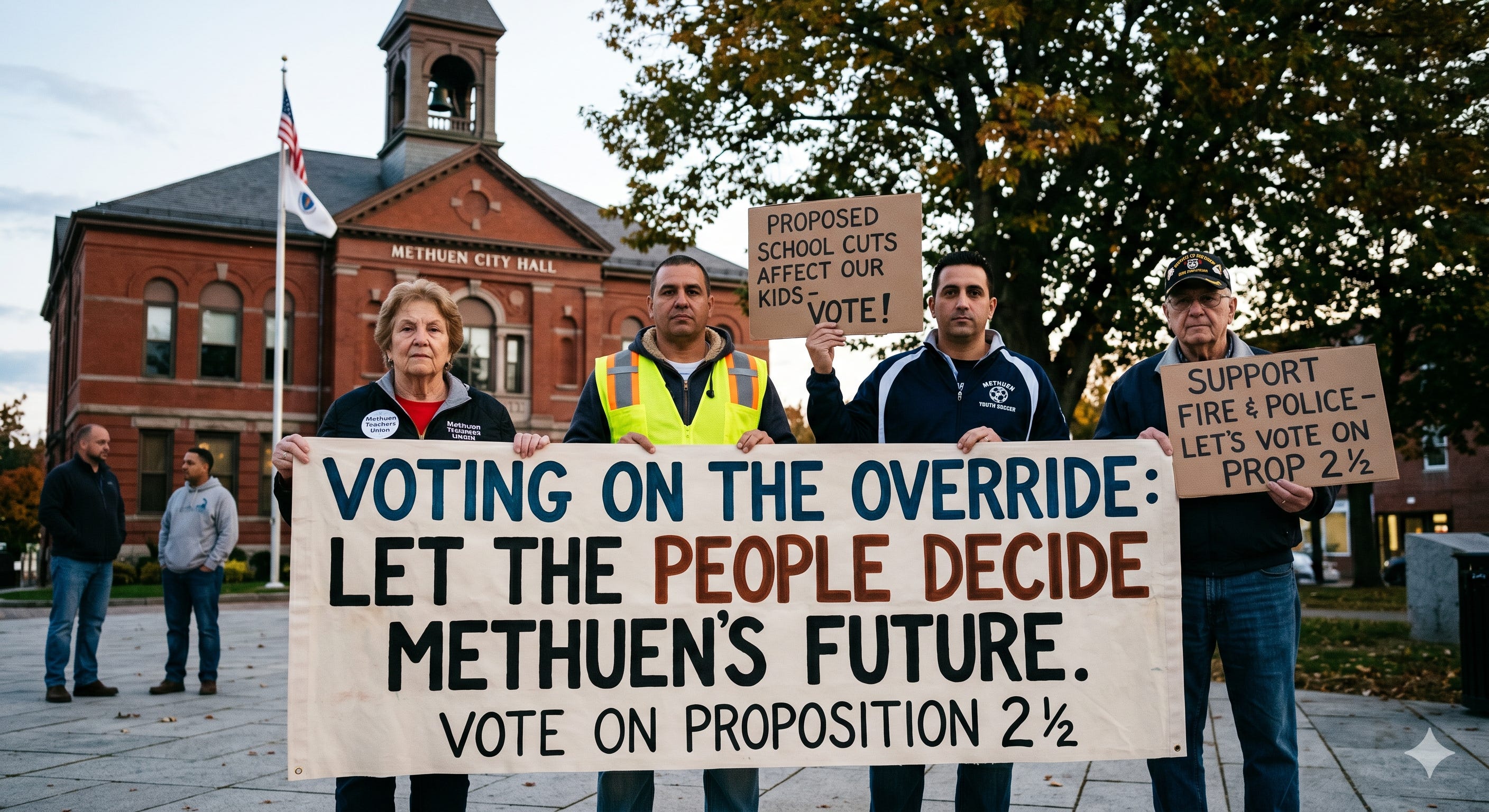
Why isn't a Proposition 2 and 1/2 override going to the people for a vote?
First, What Is Proposition 2 and 1/2? People talk about it but not many truly understand it.
Let me explain it simply, because it matters.
Proposition 2 and 1/2 is a Massachusetts law passed by voters in 1980 that limits how much a city or town can raise in property taxes each year.[1] The name comes from the two core rules it sets: the total property tax a city collects cannot exceed 2.5 percent of the full value of all taxable property in the city, and the tax levy cannot grow by more than 2.5 percent from one year to the next.[2]
That’s great but what does that mean in numbers? Here is a real-world example to which we can all relate.
Imagine your household budget is $50,000 a year. Every year, you are allowed to spend up to 2.5 percent more, so next year you can spend $51,250. That's it. You cannot spend $55,000 even if your rent went up, your groceries got more expensive, and your kids need new school supplies, unless the people living under your roof vote to allow it.
That is exactly the situation Methuen is in.
Since 1980, municipal costs have exploded with new state and federal mandates, rising health care expenses, and a technology footprint that bears no resemblance to local government in 1995. The 2.5 percent cap, however, has remained unchanged, and municipalities have become increasingly unable to meet their obligations under it.[3]
But here is the part that matters most for this conversation: the law already has a built-in safety valve. An override provision allows voters to raise additional revenues by a specific amount. This is done by placing an override question on the ballot in a general or special election and approving it by a simple majority of voters.[2]
The people get to decide. That is the whole point.
The Budget That Cannot Add Up
Methuen is trying to close a nearly $10 million school budget gap just to maintain existing programs at current levels, with no additions or increases.[4]
Rising costs in health insurance and special education have contributed to a $4 million deficit, and the potential elimination of reading specialists could result in long-term educational setbacks, with struggling students requiring even more resources down the road. Cut now, pay more later. That is the cycle.[6]
And it is not just schools. Fire, police, public health, and basic city services are all on the table. Mayor Beauregard is entering his first full budget cycle as a fully elected mayor, and the hand he has been dealt is genuinely bad. State funding for local schools increased only about 2.3 percent, which does not come close to covering an 11 percent increase in costs.
The math does not work. But there is a reason the math does not work, and it is bigger than this budget cycle.
Since 1980, without overrides, the maximum value of taxpayer contributions to communities has declined nearly 50 percent in real terms, as inflation has consistently outpaced the 2.5 percent cap year after year. Methuen has been drawing down that well for decades, and now the well is showing its bottom.[7]
Why the Override Question Should Go to a Vote
I am not here to tell you the override should pass. That is not my call. I’m just one vote and I’m not even sure, as I sit here writing this, how I would vote come the opportunity.
What I am saying is this:
The question belongs to the voters of Methuen, not to City Hall.
Proposition 2 and 1/2 was designed from the start as both a constraint and an opportunity. It constrains automatic tax growth, protecting homeowners from runaway increases. But it also creates a formal, democratic pathway for cities and towns to invest in schools, public safety, and infrastructure when voters judge it necessary. That pathway exists. Methuen should use it.[7]
Statewide, 254 of 305 Massachusetts cities and towns, fully 83 percent, have placed and passed override questions at some point, making ballot-driven revenue a mainstream municipal tool rather than a rare emergency measure. This is not radical. Communities across the Commonwealth use this process routinely.[7]
Passed overrides now provide roughly $1.3 billion per year in inflation-adjusted revenue statewide, funding recurring services and debt that communities chose to prioritize.[7] Communities like Wakefield, Winchester, Reading, Medford, and North Reading have relied on overrides to sustain services over time.[7] These are not wealthy communities doing something unusual. They are communities that chose to ask their residents a direct question and let the answer guide the budget.
If I were mayor, that is exactly what I would do. I would put the question on the ballot, give the unions, the teachers, the firefighters, the police, the parents, and the community a few weeks to make their case, and then let Methuen vote.
The Political Reality Nobody Is Saying Out Loud
There is another dimension here that deserves to be said plainly.
The budget the mayor must produce this year will have serious, painful consequences for the fire and police departments. Those two unions have historically been among the most important political forces in this city. No candidate wins a serious race in Methuen without their support. The budget cuts required by the current fiscal reality put that support at serious risk, not because the mayor wants to cut those departments, but because there is no other math.[5]
Here is what makes this moment genuinely urgent: there are no signs that next year will be better. Every indication points toward a second consecutive brutal budget cycle. That creates a window of real political vulnerability, and there are people in this city who have been positioning themselves for a long time, whether for mayor or for something else.
If the mayor navigates this crisis by making the hard cuts alone, absorbing all the political pain, and the budget is just as bad or worse twelve months from now, he will have spent enormous political capital with nothing to show for it and a fresh round of the same fights ahead.
But if an override goes to the ballot, the pain shifts. The unions get a chance to rally their members and their communities around a concrete question. The parents, teachers, firefighters, and police officers get to stand in front of their neighbors and make a direct case. And the mayor, whatever the outcome, can say truthfully that he trusted the people of Methuen with the decision, which I think he does. Although I think he feels he needs to protect the City from itself.
If it passes, the city has real revenue and the mayor has a mandate.
If it fails, the cuts that follow are no longer the mayor's cuts alone. They are the community's answer to its own question.
Where local officials genuinely believe there is a strong case to be made for generating additional revenue, they should make that case directly to voters, rather than making unilateral decisions that voters were never given the chance to weigh in on. That is sound democratic logic. It applies directly to Methuen right now.[8]
It is true that Methuen tends to move on quickly. Local politics here can have a short shelf life. A crisis today becomes background noise tomorrow.
But back-to-back years of devastating budgets are a different animal entirely. Back to back years of layoffs, service cuts, and fights over who gets hurt most create a story that is harder to shake. Two years of that narrative is what a challenger campaign is built on, and there are people watching this moment closely.
The mayor has a narrow window to change the shape of this story. The override vote is that window. It says: I believe in this community enough to ask the question directly. You decide.
Let the People Decide
Methuen does not need a mayor who stands in front of the bullet himself making all the hard calls quietly behind closed doors. It needs a mayor who respects the democratic tool that Massachusetts law has already put in place for moments exactly like this one. Oddly enough, that is exactly who I know the Mayor to be…
The override process is not a gimmick. It is not an escape hatch. It is the system working as designed: a formal, legal, democratic mechanism for a community to look itself in the mirror and answer an honest question.
How much do we value our schools, our fire department, our police, our public health infrastructure, and the basic services that make this city function?
Put it on the ballot. Let Methuen answer.
Sources
1. Wikipedia — 1980 Massachusetts Proposition 2½https://en.wikipedia.org/wiki/1980_Massachusetts_Proposition_2%C2%BD
2. Town of Rehoboth — Proposition 2 and 1/2 Questions and Answershttps://www.rehobothma.gov/assessors/pages/proposition-2-12-questions-and-answers
3. Dinsmore and Shohl LLP — Strict Property Tax Caps: A Case Study of Massachusettshttps://www.dinsmore.com/wp-content/uploads/2022/05/Article-Strict-Property-Tax-Caps..-1.pdf
4. CBS Boston — Methuen, Massachusetts Struggling to Close $9.6M School Budget Gaphttps://www.cbsnews.com/boston/news/methuen-school-budget-gap-cuts/
5. The Boston Globe — Methuen Mayor, School Committee Divided Over District Budget (June 13, 2025)https://www.bostonglobe.com/2025/06/13/metro/methuen-budget-cuts-and-teacher-layoffs/
6. LocalLens — Methuen School Committee Grapples with Budget Cuts Amid IT Consolidation Dispute (June 2025)https://thelocallens.org/methuen-school-committee-grapples-with-budget-cuts-amid-it-consolidation-dispute/
7. Stoneham Civic Ledger — A History of Proposition 2 and 1/2 Across Massachusetts and in Our Neighborhoods (October 2025)https://stonehamcivicledger.substack.com/p/a-history-of-proposition-2-across
8. Tax Foundation — MA Proposition 2 and 1/2 Is Working (November 2025)https://taxfoundation.org/research/all/state/massachusetts-property-tax-proposition-2-12/