

By Jennifer Loiselle, Liberation Art Studios
What does it mean to advocate for the arts?
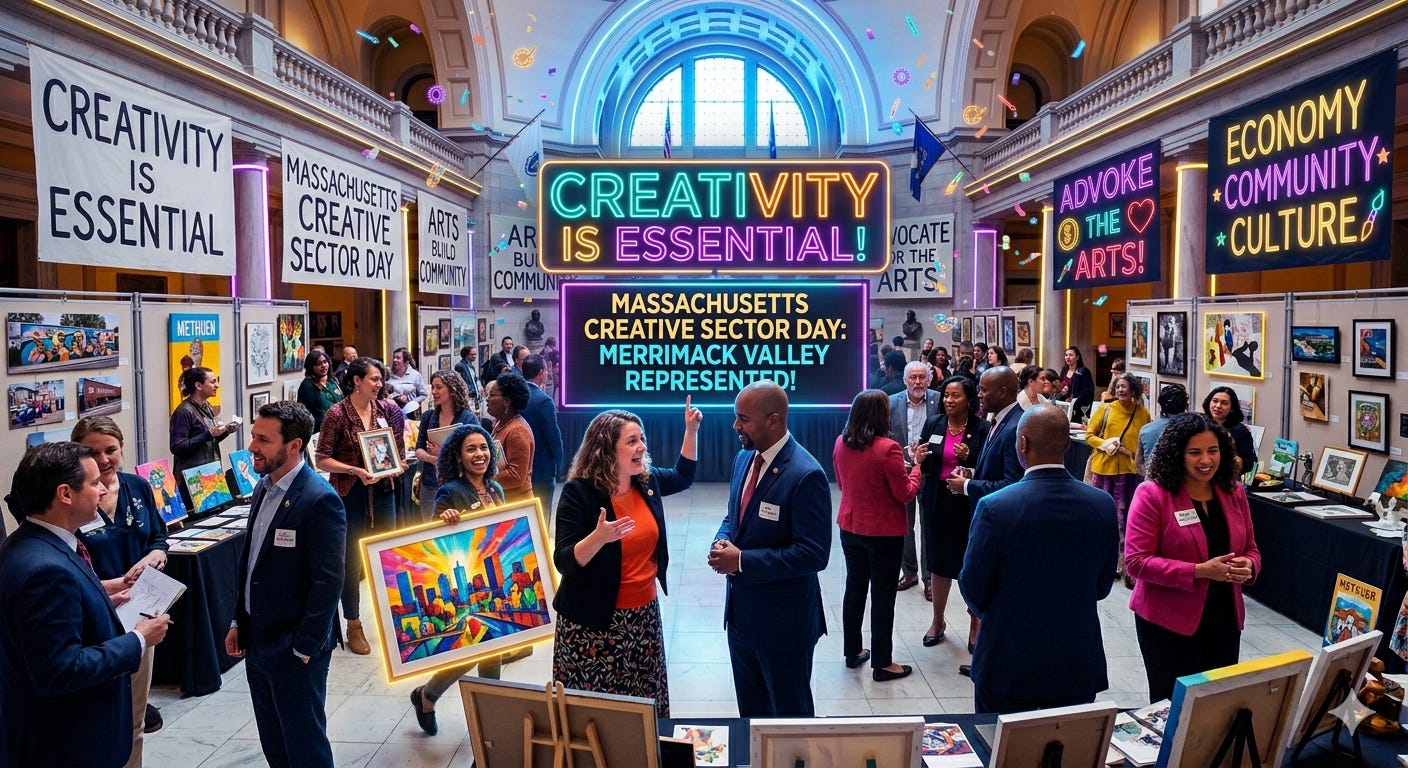
At its core, arts advocacy is about ensuring that creativity is recognized not as an extra, but as an essential part of how communities grow, connect, and define themselves. That idea was on full display at the Massachusetts State House during Mass Creative Sector Day, where artists, cultural leaders, and policymakers came together to strengthen the future of the creative sector across the Commonwealth.
On March 3rd, I had the honor of representing Methuen and the Merrimack Valley at the Massachusetts State House for Mass Creative Sector Day. While being selected as one of 30 visual artists to exhibit was an incredible personal milestone, what stood out most was something much bigger than any one artist, it was the collective power of the creative community coming together in a shared space of advocacy.
Mass Creative Sector Day is not just about showcasing artwork. It is about bringing artists, cultural leaders, and elected officials into the same room to ensure that the arts are recognized as an essential part of our communities - socially, culturally, and economically.
Throughout the day, there was an undeniable energy in the building. As Mitchel Ahern, Director of Operations at the Museum of Printing in Haverhill, described it, what stood out most was “the quantities and qualities of enthusiasms in the room.” That enthusiasm wasn’t just excitement, it was a reflection of how deeply people care about sustaining and growing the creative sector across Massachusetts.
For those of us from the Merrimack Valley, representation in spaces like the State House carries real meaning. “It was important for the area to be represented,” Mitchel shared, something I felt deeply as well. Too often, conversations about arts and culture are centered in larger cities, but our region is filled with artists, educators, and cultural organizations doing impactful, community-driven work every day.
That work takes many forms. From teaching workshops and preserving history to creating public art and building spaces for connection, artists contribute to the identity of a place. As Mitchel explained, “Arts and culture define the nature of communities for themselves, and represent those communities to the wider world.” In Methuen, we see this reflected in the murals, programs, performances, and creative initiatives that continue to grow year after year.
But beyond identity, the arts are also a vital part of a community’s infrastructure. Advocacy ensures that this work is supported, funded, and sustained. It creates opportunities for artists to thrive and for communities to benefit from the creativity that surrounds them.
This is why engagement between policymakers and the creative sector is so important. “Artists and cultural workers are the glue that holds communities together,” Mitchel noted. “They instill pride, help represent communities to others, and create economic activity that drives local economies.” These are not abstract ideas, they are real, measurable impacts that shape the health and vibrancy of our cities and towns.
Events like Creative Sector Day offer a glimpse into what is possible when these connections are prioritized. They create space for dialogue, recognition, and forward momentum. They remind us that the arts are not an extra, they are in fact essential.
For me, the day was both affirming and motivating. It reinforced why I have dedicated myself to arts advocacy since moving to Methuen in 2017, and why I continue to build community through initiatives like Methuen Artists Unite and Liberation Art Studios.
Most of all, it gave me hope.
As Mitchel simply put it, what gives hope for the future of the arts in Massachusetts? “Events like Creative Sector Day.”
And after experiencing it firsthand, I couldn’t agree more.