

Written by: Dan Shibilia
With the preliminary conversations around the school budget and the scheduling announcement for budget meetings, it is official… budget season is upon us. Every year, Methuen goes through the same exercise. In some ways, it’s pretty typical, but of course, we have to make it special in our own dramatic fashion.
The problem is that most people don’t understand how a municipal budget is formed. Where does the money come from? What are the commitments? Who does it? When? What are the roles of the three players (the mayor, the city council, and the school committee)?
Let’s talk about it.
I think the first and most important thing to understand is where the money comes from that funds our budget. We have four sources of revenue….
1. Property Taxes
Property taxes are the single largest source of income for Methuen, making up more than half of the total budget. For FY26, the city expected to raise approximately $116.7 million through real estate and personal property taxes. This is what you and I pay on our homes and business owners pay on the land their businesses own.
It may be good to know that the city cannot just raise taxes whenever it wants. Under a state law known as Proposition 2 1/2, the total amount the city collects in taxes (the “levy”) can only increase by 2.5% each year, plus any “new growth” from new construction or renovations. This creates a tight ceiling. Even if the city’s costs for electricity or health insurance go up by 10%, its main source of income is legally restricted to that small annual bump.
2. State Aid (The “Cherry Sheets”)
The second-largest chunk of money comes from the State. These funds are nicknamed “Cherry Sheets” because they used to be printed on cherry-colored paper. The current operating budget was prepared expecting about $76 million from the State. This money is vital for keeping the city in the green but it comes with a catch: much of it is “earmarked,” meaning the state dictates exactly how it must be used. For example, you may have heard the terms “ch. 90” (road repair), “ch. 70” (schools) and “circuit breaker” (Special Ed ) tossed around at meetings. Funds come tied to these specific chapters which means you can’t use those designated funds on anything else . Circuit Breaker reimbursements, money sent back to the city to cover high-cost special education services, helped bridge a major gap in this year’s school budget.
3. Local Receipts
This category covers the smaller fees and charges you pay directly to the city throughout the year. It includes:
Motor Vehicle Excise Taxes: The bills you get for owning a car.
Permit Fees: What you pay to the building department for a new deck or roof.
Meals and Billboard Taxes: Small percentages of local sales that go into the general fund.
Fines and Interest: Money collected from overdue bills or parking tickets.
These “local receipts” used in our current budget are about $18.1 million in 2026.
4. “Free Cash”
Finally, the city can/may use what it calls “Free Cash”. Free Cash is essentially the surplus money left over from the previous year’s budget after all the bills were paid and the books were closed/audited. The thing people forget about Free Cash is that it’s for one time purchase. It’s not meant to be used to fund recurring costs. The theory is that if you need to dip into Free Cash because you don’t have the money… you probably can’t afford it next year either.
Now that we know where the money comes from, let’s talk about the players and how the budget gets created.
Methuen operates on a fiscal year that runs from July 1 to June 30. That means every year, the city must have a fully approved spending plan in place before the new fiscal year begins. The budget covers everything from police and fire to road maintenance, city administration, and schools.
The Mayor, as the chief executive (think president of Methuen) is the architect of the budget. The whole process formally begins with him. Under the City Charter, the Mayor, after consultation with the Chief Administrative Financial Officer, prepares and submits annually to the City Council a Capital Improvement Program at least thirty days prior to the final date for submission of the operating budget. Then the Mayor works with department heads (except the Superintendent of Schools, as that falls to the School Committee) to develop the budget.
In practical terms, the Mayor’s team spends the late winter and early spring gathering department-by-department requests, projecting revenues (property taxes, state aid, fees, and other sources), and assembling a proposed operating budget.
Once the proposed budget is ready, the Mayor must post the entire budget document on the city’s website, where it remains posted throughout the City Council review process.
It’s important to note that while the mayor is doing his thing, the School Committee is trying to figure out how to balance its department budget. The goal/process is that the Mayor gives the Superintendent and the Committee a fiscal allocation number (how much money the city is kicking in to fund education) by late February or early March. This allows the administration and the Committee time to figure out how they want to budget. This is usually where the trouble starts. But that’s a different article for a different day.
Once the Mayor submits the proposed budget, the Council takes center stage. Councilors review the proposals line by line, hold public hearings so residents can weigh in, and can amend the budget before voting on final adoption.
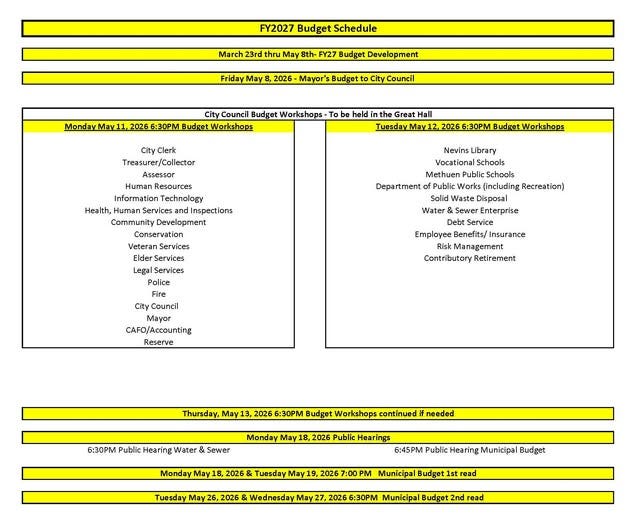
They make cuts on the department level all the way down to the line level. They will go through this exercise and finally vote to approve a budget.
The council, especially in recent years, has been very vocal that they do not set the budget. This is very true. However, the mayor’s budget is a reflection of the contracts approved by the Council and School Committee. Councilors will routinely jostle to ensure that their pet project or their friend is fully funded. They also use their political capital to pressure budget decisions. So while the original statement is accurate, to believe that no politics is being played behind the scenes is naive.
One of the least understood aspects of municipal budgeting is how much of it is already decided before the Mayor ever submits a proposal to the City Council. The reason comes down to three words: collective bargaining agreements, or CBAs.
CBAs are legally binding contracts negotiated between the city and its employee unions. We have CBAs covering teachers, police officers, firefighters, public works employees, and other municipal workers. These contracts typically run for three years, meaning that a contract negotiated and signed in 2023 is still directly shaping what Methuen must budget for in FY2026.
Inside those contracts are the details that drive personnel costs: annual step increases, cost-of-living adjustments, healthcare contribution rates, overtime rules and rates, and other compensation terms. The city is legally obligated to honor them. That means when the Mayor sits down to build a budget, a significant portion of the spending, the largest portions since personnel is typically 70-80% of a municipal budget, isn’t really a choice. It’s a contractual commitment.
This is where budget decisions get real for residents. Each position in a city department carries a cost: salary, benefits, and associated expenses. When a department’s budget appropriation comes in lower than what’s needed to fully fund its existing staff at contracted rates, the math only works one way … someone loses their job. Sometimes, who that will be depends on how the CBA is drafted.
This isn’t a management preference. It’s arithmetic. If the Methuen Police Department, for example, is funded at a level that can only support 85 officers when it currently employs 90, and the CBA sets what each officer must be paid, there is no mechanism to keep all 90 employed. This is when we have layoffs. This is why school budget hearings so often turn emotional. When a parent hears that the school budget is being cut by several million dollars, what they’re really hearing is: layoffs are coming and class sizes will rise / services will decrease.
Since CBAs typically include annual automatic raises tied to years of service (these are called step increases), the cost of maintaining the same workforce grows each year, even without adding a single new employee. A budget that looks flat from one year to the next is actually a cut in real terms, because it fails to account for those built-in increases.
So, why does this even matter …
The city budget isn’t an abstract document. It is a priority document. It says what we want to be as a City and where we are going. It determines how many police officers are on patrol, how many students are in each classroom, how many roads get paved, and how city services are staffed. Every Methuen resident has a stake in it and every resident has the right to show up, speak at a public hearing, and make their voice heard before the final vote.
Budget season can feel like insider politics. But at its core, it’s one of the most direct ways a community decides what it values and who it’s building its future for. Take an active role in the process! Pay attention. Be vocal about what matters to you and hold your elected officials accountable.
Sources:
Budget Archive: https://www.methuen.gov/Archive.aspx?AMID=39