

Written by: Dan Shibilia
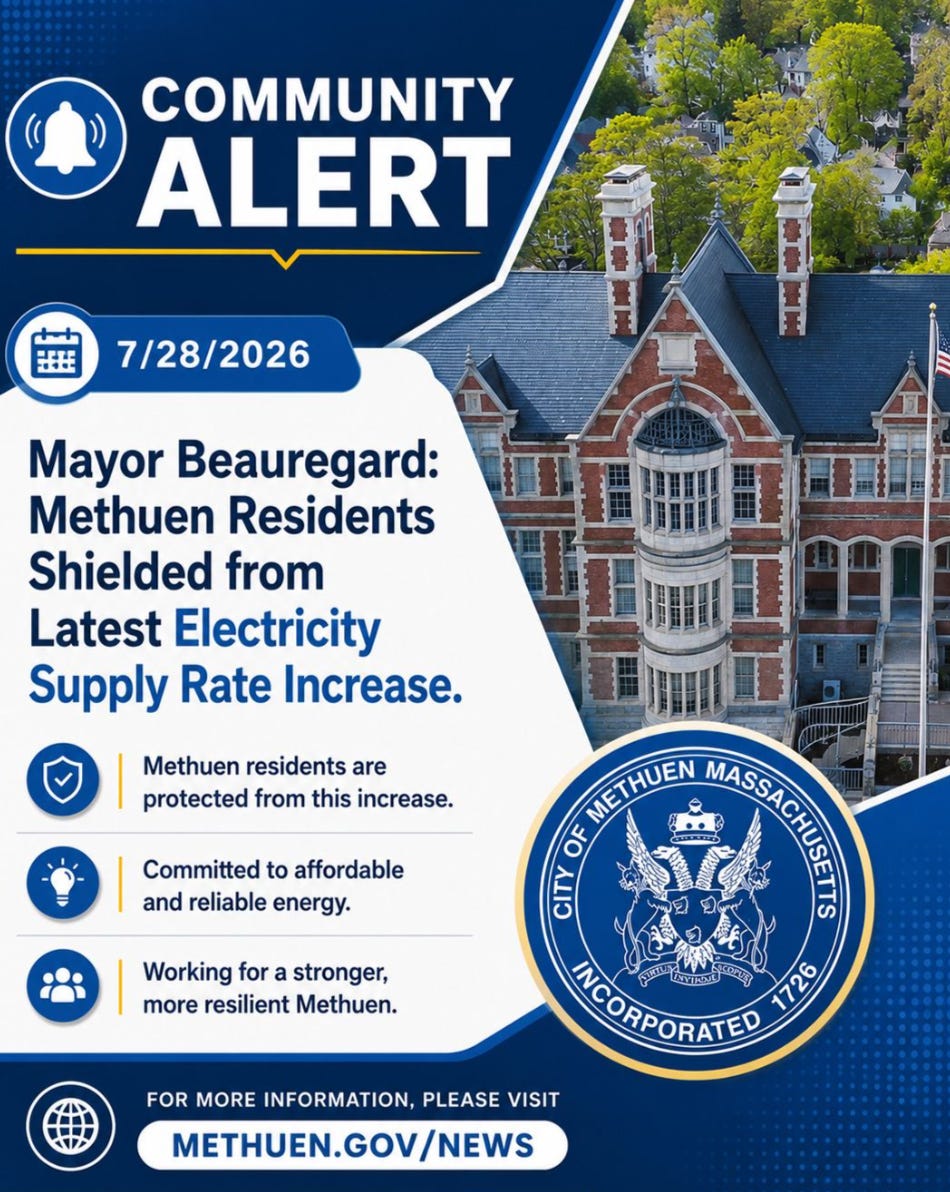
Starting in August, most Massachusetts households on National Grid's standard electricity plan will see the supply portion of their bill climb again. Methuen residents enrolled in the city's Community Choice Power Supply Program won't… their rate is locked, and has been for a while.
Mayor Beauregard's office put out the reminder this week, and the headline number is real: participants are paying about 25 percent less for the supply part of their electricity than neighbors on National Grid's new rate. But 25 percent of what, exactly, is the part worth slowing down on — because it's smaller than it sounds, and there's a catch worth understanding before you decide it's a win.
Here's the plain-English version.
What actually changed
Your electric bill has two big pieces: supply (the cost of the electricity itself) and delivery (the cost of moving it to your house over the wires). They're listed separately on your bill.
The city has no control over delivery. It can shop around for supply on behalf of residents, which is what the Community Choice program does. Right now:
National Grid's Basic Service supply rate rises from 15.568¢ per kilowatt-hour to 17.185¢ in August.
Methuen's Community Choice rate stays put at 12.83¢ per kilowatt-hour — locked through December 2027 under a three-year deal the city signed.
So the gap between the two is about 4.4¢ per kilowatt-hour. That's the "25 percent less" figure — and it's accurate, as far as the supply line goes.
What it means for your wallet — the honest math
A typical Massachusetts home uses somewhere around 600 kilowatt-hours a month. At that usage, here's the difference the locked rate makes versus National Grid's new rate:
About $26 a month, or roughly $310 a year, in supply savings.
Of that, about $10 a month is brand new — that's the piece created purely by August's increase. The rest is savings the program was already delivering.
That's genuine money, and over a full year it adds up. But notice what it isn't: it's not 25 percent off your whole bill. Because delivery charges (which nobody's cutting) often run as large as supply, a $26 supply savings on a $160–$180 monthly bill works out to more like 14 to 17 percent off the total — real, but not the number that grabs the eye.
Bigger homes, electric heat, or heavy summer AC push the savings higher. A small apartment pushes it lower.
Municipal aggregation — the formal name — lets a city bundle all its residents together and negotiate one electricity supply rate, the way a big employer negotiates group health insurance. More buying power, better price. Roughly 200 Massachusetts communities now do it.
A few things people get wrong about it:
It's not a different power company. National Grid still owns the wires, still reads your meter, still sends the bill, and still handles outages. Only the supply line changes.
You can leave anytime, with no penalty, and you can join anytime if you're currently on Basic Service or a third-party supplier.
It's opt-out, not opt-in for eligible households — which is why about 2,800 residents recently got a mailer reminding them the program exists and how to enroll if they'd landed on Basic Service or a private supplier instead.
The catch worth knowing
A locked rate is a bet, and it's fair to say so. Right now the bet is paying off handsomely, because National Grid's rate jumped well above Methuen's 12.83¢. But Basic Service resets every six months and moves with the market. If it ever drops below 12.83¢ in some future stretch — which has happened in past low-price periods — aggregation customers would briefly be paying more than Basic Service customers during that window.
That's the trade-off with any fixed rate: you give up the low lows to avoid the high highs. Given how volatile Massachusetts energy prices have been, locking in below 13¢ through the end of 2027 looks like a smart hedge. It's just not a guarantee of being the cheapest option every single month.
The bigger picture
The mayor's office points to a recent Boston Globe analysis finding aggregation programs save Massachusetts consumers around 10 percent on supply statewide, on average. Methuen's current rate beats that — more than double it against National Grid's August rate. The city says the program returned nearly $1.9 million in supply savings to participating households last year.
"Government should look for every opportunity to lower the cost of living," Beauregard said, while being candid that the city can't fix affordability by itself: "The reality is that electric bills are still too high." That's a fair way to frame it. This doesn't rescue anyone from a painful bill. It shaves a few hundred dollars a year off the one line the city can actually touch.
What to do
Pull out your most recent electric bill and find the "Supply" section. It tells you who's actually supplying your electricity:
If it says Colonial Power Group / Community Choice, you're already in — the locked rate is yours, and you don't need to do anything.
If it says National Grid Basic Service, you'll get the August increase unless you enroll. You may be able to do better by joining.
If it lists a third-party supplier, compare their rate to 12.83¢. Some private supplier deals start cheap and then balloon after an introductory period, so check the actual per-kWh number
To check eligibility or enroll, visit www.colonialpowergroup.com/methuen or call Colonial Power Group at (866) 485-5858, ext. 1.
Five minutes with your bill is the only way to know which side of this you're on — and for a lot of Methuen households, it's the difference between paying the August increase and skipping it entirely.
Original press release: