

Written by: Dan Shibilia
For those of you who don’t get the Eagle Tribune and didn’t see the article, last Tuesday (8/18), the School Committee held a meeting of the School Finance Committee. It was held in the Superintendent’s office and was overall unremarkable for the first 30 minutes. Then the CAFO dropped a bomb and the Mayor backed her.
You can watch the meeting here. This happened around the 30-minute mark.
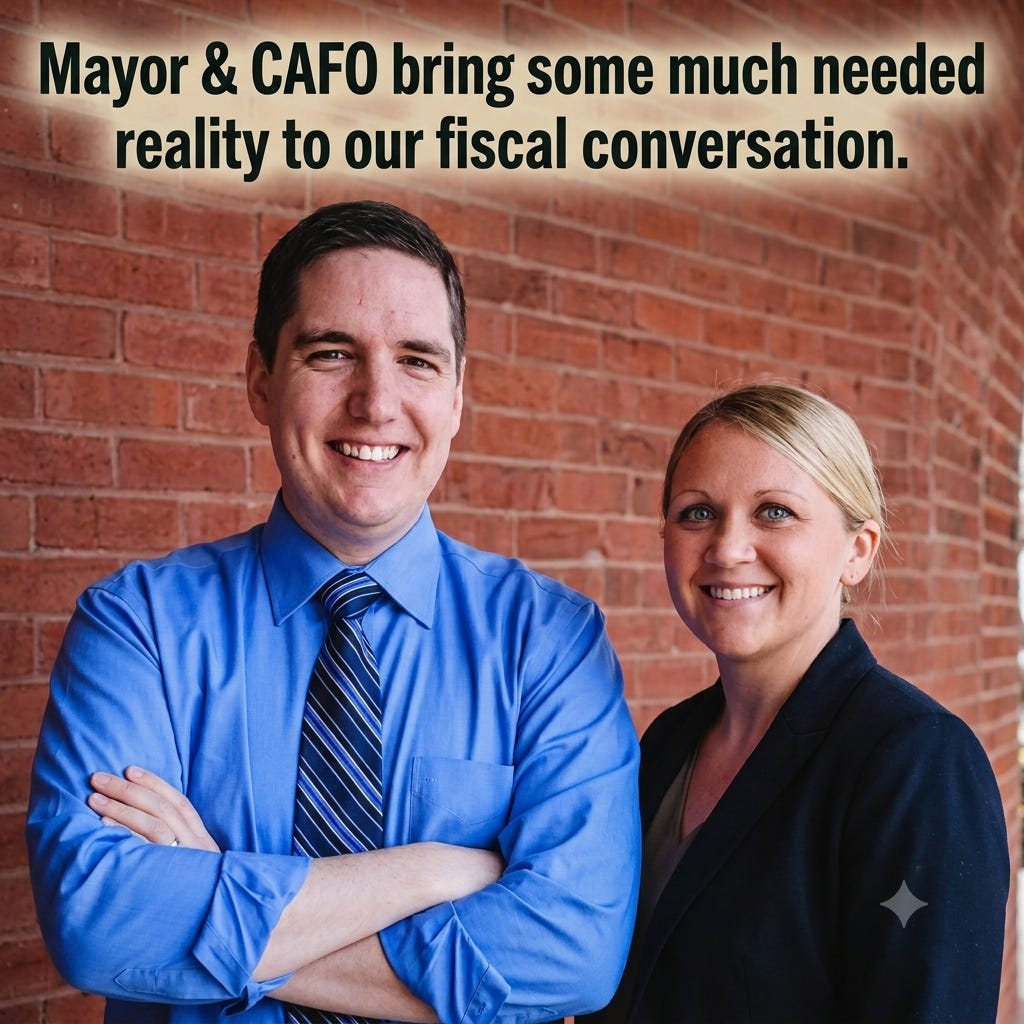
Chief Administrative and Financial Officer Maggie Duprey told the room she would recommend against any raise in the first year of every new municipal contract negotiated this fiscal year. Police, secretaries, building inspectors, and school nurses are all set to expire before the end of next summer.
Mayor Beauregard didn’t let her carry that alone.
He backed her up in the room, saying it would be irresponsible to even consider anything beyond a zero in year one.
Do you understand how impactful this is?
That is not a normal thing for an elected official to say out loud, especially about union contracts, especially with elections coming next November which is not long after these contracts would need to be signed.
The biggest issue with this statement… they are right.
Methuen didn't arrive at this moment overnight. Years of contracts that outpaced revenue, spending that didn't always get the scrutiny it should have.. or any at all…, and projects that got started and then quietly forgotten or completely ignored all added up. Some of those same contracts were approved back when Beauregard was still on the council, which makes this moment a little more complicated for him personally. But even under the most optimistic revenue projections at the time, those deals negotiated by Mayor Perry were never going to hold up against a 2.5 percent levy cap forever. Someone was eventually going to have to say so and that is like signing your own death certificate.
Reality is, Massachusetts law caps how much a city can grow its total tax levy each year at 2.5 percent, override votes aside. Methuen has been handing out raises closer to 3 percent in recent contracts. Add in the rising cost of special education, transportation and insurance, and you get exactly what the city has been living through for years, a budget that never quite balances and reserves that keep getting drained to cover the gap. Beauregard put it plainly. The city is overextended.
None of this is a knock on the employees asking for more. Plenty of them have earned it, and plenty of them need it. That is what makes this hard. Nobody wants to be the person telling teachers, dispatchers and secretaries that this isn’t the year. It would have been so much easier for the mayor to let the finance officer be the bad news and stay quiet himself. He didn’t do that. He stood next to her and owned it. Kudos to them both!
It is worth being clear about the statement the Mayor and CAFO made during this meeting… this is about the Cost of Living Adjustments (COLA) that the unions get in addition to their step increases. Step increases are the yearly increases that come from just surviving and making it to the next year. Those steps are all different percentage increases based on a table that has long existed and does get updated from time to time during collective bargaining. The Unions also get COLA’s on top of that increase. We usually hear "it’s only 3/3/3” which would mean it's a 3-year deal giving a 3% raise each year. However, that is never truly the case.
It also helps to understand why a contract that looks like 3 percent, 3 percent, 3 percent on paper never actually costs the city just 3 percent a year. That number is only the cost of living piece. Layer step increases on top of it for every employee who isn’t already at the top of the scale, and the real year-over-year growth in payroll is higher than the headline number suggests. Then add everything that rides along with a union contract beyond salary, health insurance premiums that the city mostly covers and that climb every year on their own, longevity pay, overtime rates calculated off the new higher base, sick and vacation buyback, pension contributions tied to salary. For some unions, they get loads of special stipends to get accreditations, and clean their uniforms, and wear a body camera, and so many other things. A 3 percent raise on the surface can easily translate into a much bigger real increase in what the city has to budget for that same group of employees. That is the part that rarely makes it into the conversation, and it is a big reason why a levy cap of 2.5 percent and a raise pattern of 3 percent were never going to coexist for long.
Beauregard also isn’t pretending the city can fix this alone. He pointed to Beacon Hill, noting that Governor Healey’s push for a hundred million dollars in supplemental school funding is exactly the kind of help cities like Methuen need, even though he isn’t optimistic the legislature will come through. That is a mayor doing both jobs at once, making the unpopular call at home while still asking the state to do its part.
None of this comes free, politically.
Municipal unions turn out voters. They organize, they endorse, and they remember who stood with them and who didn’t. Telling them this far out, before negotiations have even really started, that this isn’t their year is exactly the kind of thing that gets brought up at every doorstep and every union hall until the election results post. Beauregard knew that when he said it. He said it anyway.
That is worth noticing, because most elected officials in his position wouldn’t.
The easier path is well worn. Let the finance officer deliver the bad news. Stay vague in public. Let the actual numbers come out quietly during negotiations, away from cameras, so there’s no soundbite to run against later. Plenty of mayors have managed entire careers that way, saying just enough to sound responsible without ever putting themselves on the record in a way a union could use.
That is performative politics and what Methuen has far too much of these days.
Beauregard didn’t take that path.
He stood with Duprey and said the number out loud, in a public meeting, months before any contract negotiations actually even started. That is not the move of someone protecting his own reelection. It is the move of someone who decided the city’s finances mattered more than his own political comfort right now.
Methuen has spent years avoiding this conversation because it was easier not to have it. Same goes for the insurance issues Beauregard just settled. Every year that went by without anyone saying it plainly just meant a bigger problem for whoever finally did. Now someone finally had it, in public, knowing exactly what it might cost him.
That is not the kind of thing that should end a political career. It is the kind of thing that should be rewarded. If Methuen wants more honesty out of the people who run it, this is what that honesty actually looks like when it shows up. It rarely arrives at a convenient time, and it never arrives without a cost to the person saying it.