

Written by: Dan Shibilia
Down the road in Dracut, cannabis tax money has paid for a fire truck, a fleet of police cruisers, new classroom computers and a wheelchair lift at an elementary school. In Methuen, where voters have twice said no to allowing legal marijuana sales, school officials this spring were drawing up layoff lists and city departments have leaned on furloughs to balance the budget. Those two facts sit right next to each other on a map, and they are worth examining together and saying outloud that this is a mess we created.
A Question Methuen Has Asked Twice
Massachusetts voters legalized recreational marijuana statewide in November 2016 through Question 4, approving it by a margin of about 54 percent to 46 percent. The law let any city or town that voted no on the statewide question hold its own local vote later and opt back in, but it also meant that communities which rejected Question 4 could not host marijuana businesses unless they voted to allow it themselves.
Methuen was one of the communities that voted no. According to reporting in The Eagle Tribune, 11,050 Methuen voters supported the statewide measure while 11,869 voted against it. That's a difference of 819 votes out of roughly 23,000 cast…in a city of (at that time) about 50,000 people. That single, narrow margin set the course Methuen has followed ever since.
City Hall did not let the issue rest. In 2018, then Mayor James Jajuga formed a Cannabis Policy Working Group to study how marijuana might fit into Methuen if attitudes changed. In 2019, that group surveyed more than a thousand residents and found that 57 percent strongly agreed or agreed with allowing licensed marijuana retailers to open in the city. The working group drafted an ordinance that would have allowed medical marijuana cultivation and retail in limited areas, but the City Council amended it so heavily that, by January 2020, it would have been functionally impossible to open any marijuana business anywhere in Methuen, and the chairman withdrew it.
The question came back one more time. In May 2021, the City Council voted eight to one to place a binding local question on the November ballot, asking voters directly whether to allow the cultivation, transportation and sale of marijuana for all purposes legal under state law, including adult recreational use. Supporters pointed to neighboring Haverhill, which had approved the 2016 statewide question and was already collecting substantial fees from cannabis sellers. Opponents argued the matter had already been settled in 2016 and that the new question was confusingly written.
Voters decided again. On November 2, 2021, Methuen rejected the local cannabis question by a margin of 57 percent to 43 percent, according to results reported by The Eagle Tribune and the cannabis industry trade outlet MJBizDaily. As of today, marijuana retail, cultivation and delivery businesses remain prohibited in our city.
What the Money Has Done Next Door
Dracut sits directly across the line from Methuen, has roughly 32,600 residents (compared with Methuen's roughly 53,000), and voted to allow cannabis businesses. A summary graphic that circulated on the City of Dracut's official Facebook page lays out, in plain dollar figures, what that decision has meant for the town's budget. The graphic carries a disclaimer noting it is not an official town document but rather a summary of free cash capital purchases, stabilization fund transfers and school bond items approved at town meetings between 2020 and 2027, and it is treated here as illustrative rather than as audited financial data.
According to that summary, Dracut's cannabis excise tax revenue has tracked as follows:
Year Cannabis Revenue Received
2021 $533,932
2022 $2,627,408
2023 $2,732,695
2024 $1,924,198 (declined after the Commonwealth eliminated local cannabis impact fees)
2025 More than $1.5 million (estimated, not yet disclosed)
That comes to roughly nine million dollars flowing into Dracut's town accounts over five years, money raised entirely from a product Methuen has chosen not to sell. Dracut put that money toward thirteen capital projects valued at more than one hundred thousand dollars a piece, among them a fire department pumper truck for $830,000, extra road resurfacing and hardscape work for $700,000, replacement police vehicles for $652,000, a Department of Public Works roof replacement for $300,000 and a multi purpose DPW truck for $250,000. The schools benefited too, with cannabis and free cash funds covering a $200,000 roof design, $200,000 in classroom computers, a $200,000 network switch and router upgrade and a $140,000 wheelchair lift to make the Brookside School accessible. Surplus cannabis revenue has also gone toward yearly deposits into the town's stabilization funds, averaging about $250,000 a year between 2021 and 2027, plus partial debt service on a new fire station and ADA and roof projects at two more schools.
None of that is money Dracut had to raise through an override, a new fee or a layoff. It is money a legal industry generated and handed to the town in tax revenue, on top of what residents already paid in property taxes.
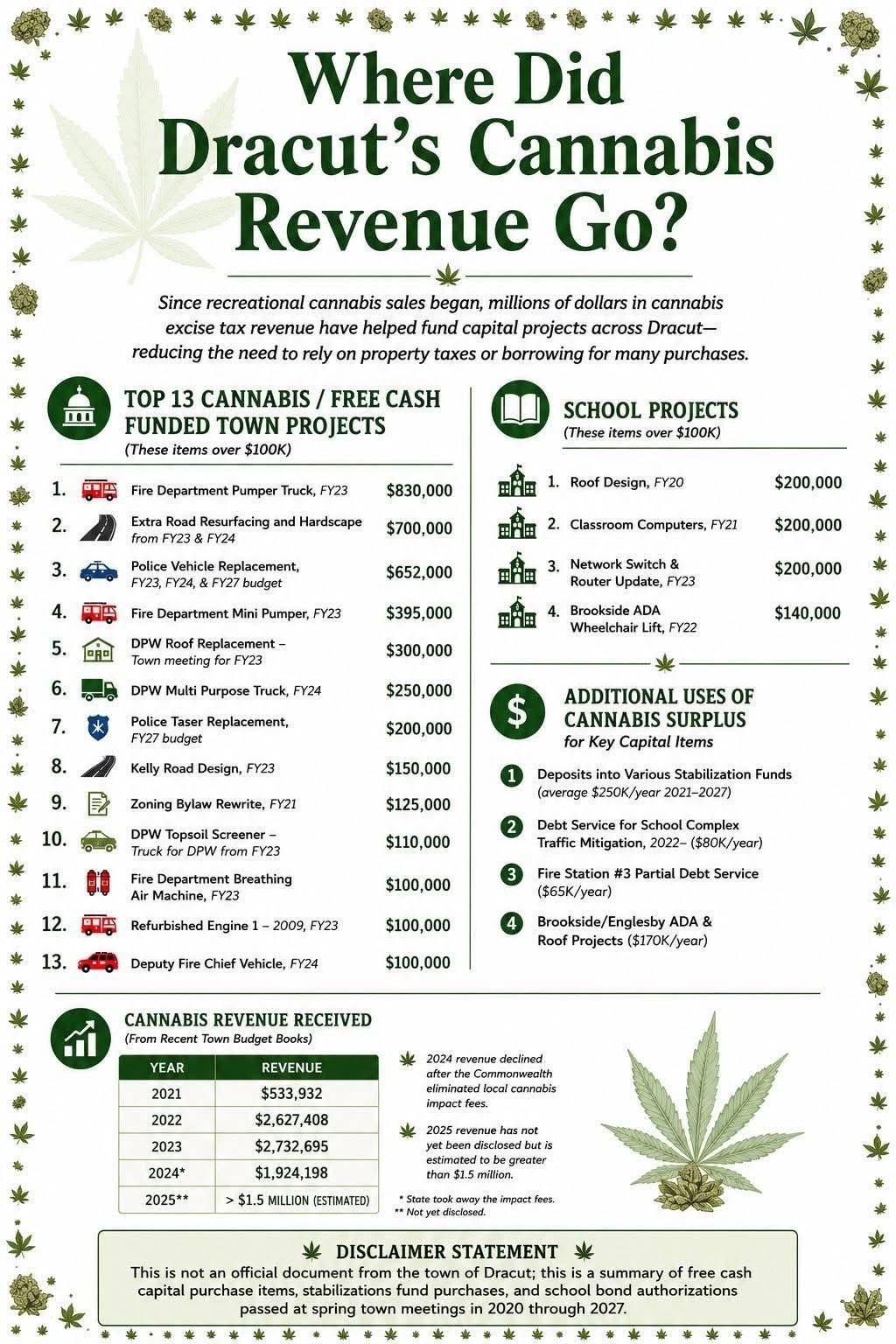
Graphic circulated on the City of Dracut, Massachusetts Facebook page, summarizing cannabis and free cash funded capital projects approved at town meetings from 2020 through 2027.
What That Could Have Meant for Methuen
Methuen is roughly one and a half times the size of Dracut. Scaling Dracut's five year cannabis revenue total to Methuen's population is a rough exercise, not a budget projection, since revenue depends on how many shops open, how much they sell and how local fees are structured. But even a conservative, population adjusted estimate puts the number somewhere in the neighborhood of ten to fourteen million dollars over five years, money that simply does not exist in Methuen's accounts because the product is not legal to sell here.
That number lands differently this year than it might have in 2021. This spring, Methuen school officials were finalizing layoff notices while state aid uncertainty squeezed the district's budget by more than two million dollars with district leaders hoping to recall as many positions as possible once funding firmed up. City departments have turned to furloughs to stretch thin budgets further. None of this is unique to Methuen this year, but it is the backdrop against which the city's third rejection of cannabis revenue should be read.
To be clear, nobody can promise that legal cannabis sales would have closed Methuen's budget gap on their own, or that the city would have spent the money exactly as Dracut did… this is Methuen after all and we routinely screw up a the proverbial free lunch. But Dracut's own figures, fire trucks, police cruisers, school technology and roof repairs paid for without new taxes or layoffs, are a real example of what that revenue stream is capable of funding in a community of comparable size and character, fifteen minutes up the road.
We aren't even getting into what Haverhill has done…!
Anticipating the “Gateway Drug” Argument
Opposition to cannabis sales in Methuen has often returned to a single claim: that marijuana is a gateway drug that leads users toward harder, more dangerous substances. It is worth looking at what the primary research actually says, rather than relying on the slogan alone.
The National Institute on Drug Abuse, the federal government's lead research agency on substance use, addresses this question directly. NIDA notes that some animal studies show early cannabis exposure can prime the brain for stronger responses to other drugs later, a pattern that is consistent with the gateway idea. But the agency is equally direct that the majority of people who use marijuana do not go on to use other, harder substances, and it offers a competing explanation: people who are already more prone to drug use may simply start with whatever substance is easiest to get, whether that is alcohol, tobacco or marijuana, and it is their social environment afterward, not the marijuana itself, that increases the odds they try something else.
The federal government's own National Institute of Justice reached a similar conclusion in a 2018 literature review that examined 23 peer reviewed studies on the subject. The review found that the existing statistical research on the gateway hypothesis has produced mixed results, and stated plainly that no causal link between cannabis use and the use of other illicit drugs can be claimed at this time.
That finding is not new. As far back as 1999, the Institute of Medicine, part of the National Academy of Sciences, studied the same question for a congressionally requested report on medical marijuana and concluded there was no conclusive evidence that the drug effects of marijuana are causally linked to a person's later use of other illicit drugs. Two decades and dozens of additional studies later, federal researchers still describe the question the same way: an association worth studying further, not a proven causal chain.
None of this means cannabis is risk free, particularly for teenagers, whose developing brains are more vulnerable to any psychoactive substance, including alcohol and nicotine. They can't legally buy it even if we were to vote to allow sale. But the specific claim that legal, regulated, adult use cannabis sales function as a pipeline to heroin or methamphetamine is not supported by medical research and the federal government's own research arms. Lawmakers and voters are entitled to weigh that research alongside other concerns, but the gateway slogan deserves more scrutiny than it usually gets in a council chamber or a campaign mailer.
A Question Worth Asking a Third Time
Methuen voters have said no twice, first in 2016 and again in 2021, each time by a margin under fifteen points. That is not overwhelming opposition. It is a city closely split on a question whose financial consequences have grown clearer with each passing year that a neighboring town banks fire trucks, school computers and stabilization fund deposits from a product Methuen does not sell.
As Methuen works through another budget cycle marked by layoff notices and furloughs, the figures sitting in Dracut's town accounts are a useful reminder that this is not a hypothetical revenue source. It is money a neighboring community is spending right now, on the same kinds of fire trucks, cruisers and school repairs that Methuen has had to fund some other way, or has gone without.
Sources
Ballotpedia, “Massachusetts Question 4, Marijuana Legalization (2016).”
WBUR News, “Mass. Votes To Legalize Recreational Marijuana,” November 9, 2016.
The Eagle Tribune, “Methuen City Council OKs pot ballot question,” May 19, 2021.
The Eagle Tribune, “Residents to vote on bringing cannabis to Methuen: Locals sound off,” October 24, 2021.
MJBizDaily, “Election night fallout for marijuana industry,” November 2021.
The Eagle Tribune, “Methuen school officials expect more jobs will be saved,” May 29, 2026.
City of Dracut, Massachusetts, official Facebook page, cannabis revenue and capital projects summary graphic.
National Institute on Drug Abuse, “Is marijuana a gateway drug?”, research report, accessed 2026.
National Institute of Justice, “Is Cannabis a Gateway Drug? Key Findings and Literature Review,” 2018.
Institute of Medicine, National Academy of Sciences, “Marijuana and Medicine: Assessing the Science Base,” 1999.
U.S. Census Bureau, QuickFacts, Methuen city and Dracut town, Massachusetts.
This article is intended for general community discussion. Revenue comparisons between Dracut and Methuen are illustrative estimates based on population scaling, not official projections, and actual results would depend on local licensing, zoning and tax decisions Methuen has not yet made.
To clarify, this graphic was not generated by the town of Dracut, but by the admin of Dracut Civic Watch, a volunteer-run Facebook group that has operated in Dracut since 2013.