

Written by: Dan Shibilia
When the Mayor presents a budget number for education spending, and when the School Department reports its spending to the state, those two figures are not always the same. That gap can confuse residents, School Committee members, and even elected officials. At the center of that confusion is a mechanism called chargebacks — and understanding how they work is essential to understanding how Methuen, and really every district, funds public schools.
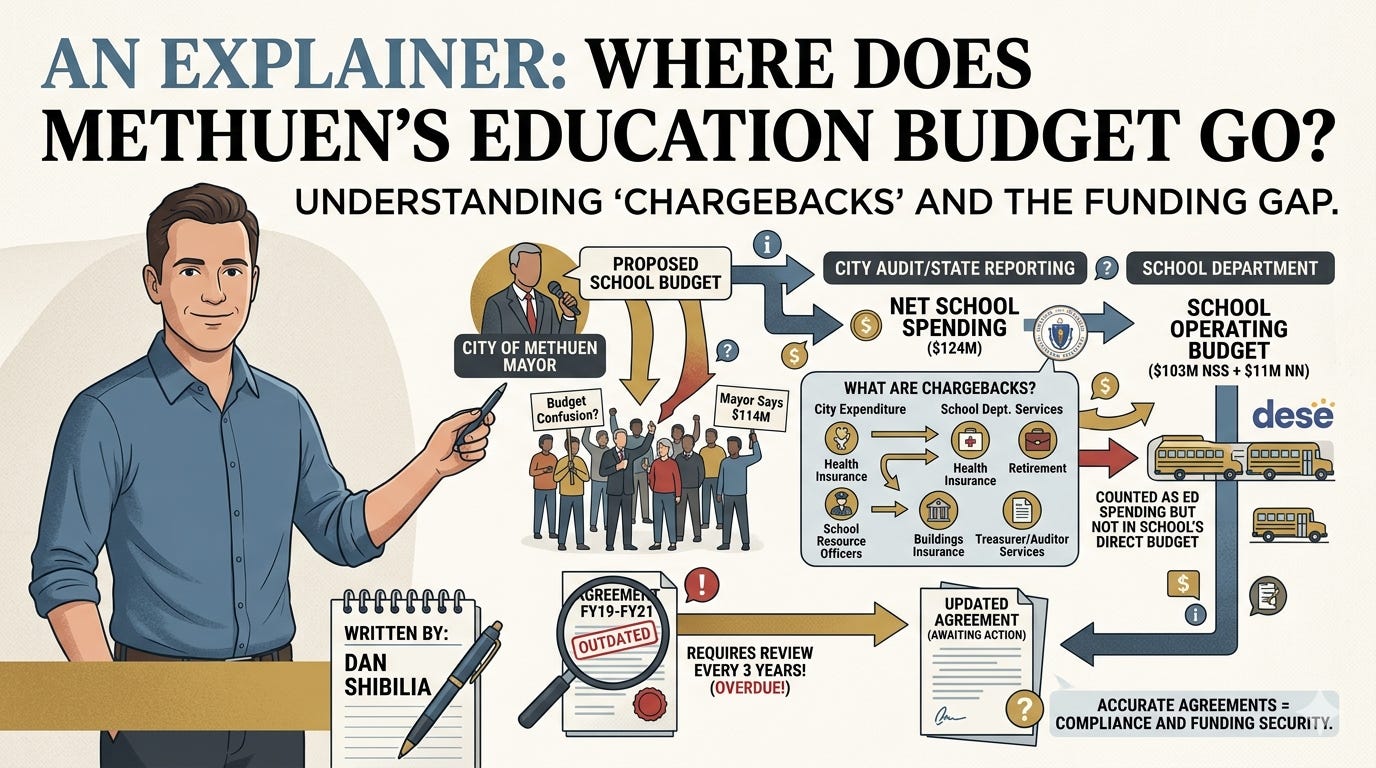
What Is a Chargeback?
A chargeback is a city expenditure made on behalf of the School Department that gets counted as education spending. These are not line items in the School Department's own budget. Instead, they are costs the City of Methuen pays directly, through services provided by other city departments, that are then attributed to the schools when reporting to the state.
Examples include the School Department's share of the City Auditor's office (which no longer exists), the Treasurer/Tax Collector's office, contributions to the city's retirement system, group health insurance, building insurance premiums, and the cost of School Resource Officers provided by the Police Department.
None of these dollars flow through the School Department's budget. But under Massachusetts law, they count toward what is called Net School Spending. Net School Spending is the minimum amount a municipality is required to spend on education each year which is set by the Commonwealth.
Why Does This Create Confusion?
When the Mayor announces a school budget number, that figure typically reflects what is appropriated directly to the School Department, net and non-net spending. Chargebacks are handled separately, through city departmental budgets, and are often not part of that public conversation.
When Methuen reports its education spending to the Department of Elementary and Secondary Education (DESE) at the end of each fiscal year, chargebacks are included in that total. This means the number residents hear in budget season and the number reported to the state can look quite different… not because of any error, but because they are measuring different things.
Lately, you've heard conversation about the $114M funding number the Mayor allocated to the schools. This breaks down to about $103M net school spending and $11M non-net spending (transportation costs, mostly). The difference between our required net school spending of about $124M and the current $103M is the total of the chargebacks.
This distinction matters. Net School Spending compliance is a legal requirement in Massachusetts. Meeting it, or failing to, has real consequences for the district.
The Agreement Behind the Chargebacks
The specific services and percentages that make up Methuen's chargebacks are governed by a formal agreement between the Mayor and the Superintendent. The document on file is titled Agreement on City of Methuen Expenditures for the Methuen School Department, and it covers fiscal years 2019 through 2021.
That agreement, now several years past its intended review period, was supposed to be revisited every three years, prior to the budget development process. By multiple accounts, a revised version has been sitting with the City's Chief Administrative and Finance Officer (CAFO) since at least January of this year, awaiting action.
You can see that document here: https://drive.google.com/file/d/10a7KR0tzZm0TJ-S8gMGKM6_BoKYrzbf-/view?usp=drivesdk
The stakes of an outdated agreement are practical, not just procedural. Former School Committee members and current committee members have noted that the existing document does not accurately reflect the current reality: there are services listed in the agreement that the School Department no longer uses, and services the School Department does use that are not captured in the agreement. Until the document is updated, the formula used to calculate chargebacks, and therefore net school spending, may not reflect what is actually happening on the ground.
Who Is Responsible?
Ultimately, the agreement requires sign-off from both the Mayor and the Superintendent, as the signatures on the current document reflect. In practice, the work of developing and maintaining it is a collective effort involving the Superintendent, the Mayor's office, and the CAFO.
The agreement's own language requires it be reviewed every three years, prior to the budget development process. The current document expired after FY21. That means Methuen has been operating under a chargeback agreement that is, by its own terms, overdue for revision while budget season comes and goes each year.
What Residents Should Know
Chargebacks are not unusual. Most Massachusetts municipalities use a similar mechanism to account for shared city-school services. The state's own guidance provides methodology for how these costs should be calculated and reported.
But the accuracy of that accounting depends on the underlying agreement being current and correct. An outdated agreement creates risk, not necessarily of wrongdoing, but of miscalculation. Services that have changed, costs that have shifted, and arrangements that no longer exist can all distort the final number reported to DESE. A finding from DESE that we missed our Net School Spending could cause serious issues for the City in terms of oversight and funds received.
For residents trying to evaluate whether Methuen is adequately funding its schools, understanding chargebacks is a necessary first step. The headline budget number is only part of the picture. The full picture includes what the city spends on the schools' behalf, and whether the agreement governing that spending actually reflects today's reality.